Salesforce vs. Microsoft Dynamics vs. HubSpot: Which CRM Is Best for Mid-Market Businesses in 2026?
March 02
CRM Configuration
Blogs

Mid-market businesses navigating 2026’s digital transformation face a true strategic crossroads: which CRM platform delivers genuine scalability, process efficiency, and future-proof growth for teams of 50–500 employees? With the rise of logic-driven automation replacing basic workflows, CTOs, VPs of Sales Ops, and IT Directors must select a solution that accelerates revenue without burdening their teams with costly IT overhead. The real contest between Salesforce, Microsoft Dynamics 365, and HubSpot isn't just about ticking off features; it’s about eliminating operational bottlenecks and maximizing ROI in a business climate where every hour and data point counts.
For growth-stage organizations, failing to select the right CRM can lead to months lost in cumbersome migrations, technical debt, and patchwork reporting. Choosing a platform aligned with your stack and maturity isn’t just a technology decision, it’s a move that shapes the next five years of sales ops, compliance, and integration. At OMI, we guide mid-market clients through hundreds of successful CRM journeys, delivering managed CRM services that blend technical expertise, rapid implementation, and a relentless focus on business outcomes. Below, we break down the landscape, highlighting hidden costs, strategic frameworks, and the most effective pathways to CRM value in 2026.
What Is the True Cost of CRM for Mid-Market Digital Transformation?
Many mid-market firms underestimate the ripple effect of a poorly matched CRM:
- Technical debt: Duplicated and orphaned data slow decision-making and erode pipeline velocity.
- Integration gaps: Manual exports and disconnected systems drive high admin overhead, sometimes as much as 40% of a sales admin’s week.
- Compliance risk: Inadequate permission sets, missing audit trails, and lack of SOC2 controls expose mid-sized organizations in regulated sectors.
Even a 15% loss of productivity due to CRM inefficiencies can quickly escalate to months of lost revenue and significant opportunity cost. These pitfalls are often only realized after committing to a platform. Proactive review upfront is essential.
Pro-Tip: Data Cleanliness Checklist – Audit CRM Technical Debt in 30 Days
- Days 1–7: Export and run deduplication reports; target less than 5% error rate.
- Days 8–14: Audit master-detail and lookup fields, resolving orphaned records.
- Days 15–21: Review permission sets for SOC2 and GDPR compliance.
- Days 22–30+: Test mission-critical Flows, scoring integration health.
Clients using OMI's managed CRM services often cut this manual process in half by leveraging deep Salesforce and Dynamics expertise.
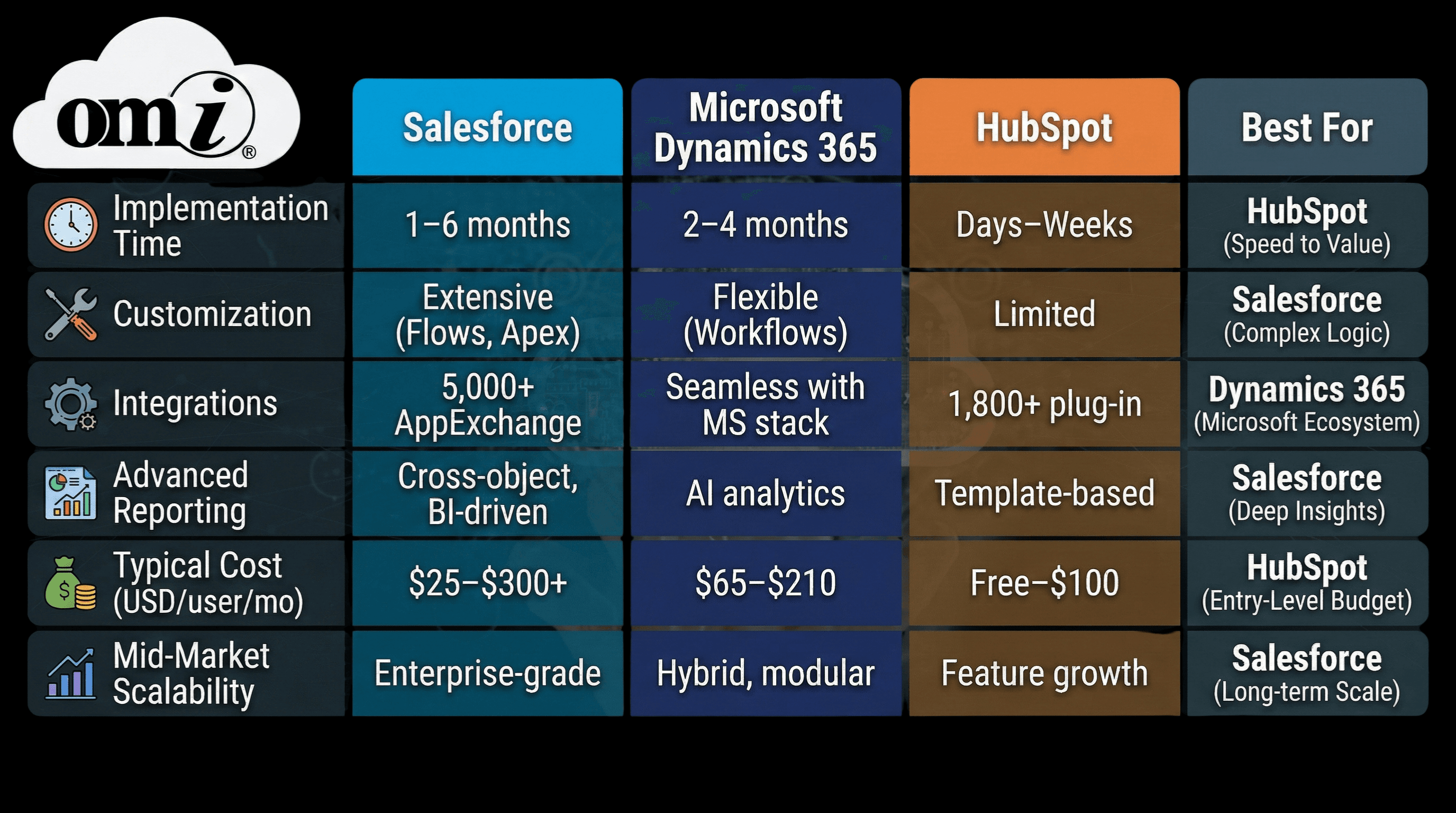
Comparison Matrix: The Big Three CRM Platforms for 2026
Feature comparison of Salesforce, Microsoft Dynamics 365, and HubSpot for mid-market CRM selection:
Pro-Tip: SDR vs. BDR Team Optimization
- For SDRs: HubSpot’s pipeline Kanban simplifies rapid lead tagging, keeping things agile.
- For BDRs: Microsoft Dynamics Copilot streamlines prioritization with seamless Outlook/Teams flows.
- Scaling Up: Salesforce Flows and advanced rule routing automate complex territory or vertical assignments as teams grow.
Process Over Platform: Why Strategy Matters Most
Vendor strengths vary, but process orchestration is the true mid-market differentiator. Selecting "the best" CRM depends as much on your workflows, data governance, and in-house expertise as on technical specs. Many companies find that partnering with seasoned experts pays off early. OMI de-risks your digital roadmap by aligning 2026's automation demands with your specific infrastructure:
- The Microsoft Ecosystem: Microsoft-centric? Dynamics is seamless, but beware vendor lock-in beyond Office 365 and Azure.
- Need rapid iteration, limited customization? HubSpot excels for quick launches; we provide the strategic oversight to ensure you don't stall when you hit the limits of its native reporting or partner integrations.
- Complex vertical sales or team scaling? Salesforce is the gold standard for deep automation, logic-driven assignments; we leverage Salesforce to build a clean, compliant foundation that scales without the typical IT overhead.
Brief Migration Guide: Avoiding the Top Pitfalls in CRM Transitions
Growth-stage firms often must migrate platforms as they outgrow initial solutions. Common traps include:
- Broken field mapping: Losing up to 30% of legacy data when moving from HubSpot to Salesforce.
- Poor user adoption: Bypassing training and documentation, leading to inconsistent records and shadow IT.
- Permissions oversight: Failing to replicate or enhance permission sets, risking regulatory non-compliance.
At OMI, our managed migration services resolve these early, delivering a roadmap that includes data deduplication, role-based training, and robust testing best practices. Our expertise in integrations (like automating dashboards with Flowgear and Salesforce) unlocks transparency and accountability across every stage of growth.
Pro-Tip: CRM ROI Quick Calculation
- Start by measuring current win rates and pipeline velocity (benchmark +15% as a target).
- Assess time reclaimed per rep after process optimization; many see 10-15 hours/week gains.
- Leverage managed CRM services for 3-6 month payback cycles on CRM investments.
Best Practices Checklist: Selecting and Optimizing CRM for Mid-Market Growth
- Evaluate stack alignment: Choose Dynamics 365 for Microsoft-first infrastructures, Salesforce for specialized workflows, HubSpot for fast, simple launches.
- Calculate total cost of ownership (TCO): Include hidden admin, customization, and compliance costs.
- Simulate for growth: Test with 100–500 simulated users to assess real scalability.
- Prioritize lead data quality and deduplication: Lay foundations for automation and reporting.
- Confirm permission management, SOC2, and GDPR readiness: Build an audit trail from day one.
- Work with proven partners: Managed CRM services accelerate transformation, reduce technical debt, and provide ongoing support.
The ROI Angle: Time Reclaimed and Cost Savings from CRM Optimization
For mid-market businesses, the real payoff is measured in operational efficiency, standardized processes, and reduced IT costs. Auditing technical debt and outsourcing CRM admin to experts allows teams to reclaim up to 40% in resource allocation and see pipeline velocity improvements of 15-28%. These gains are unlocked through streamlined workflows and robust business intelligence, not just 'AI-powered' enhancements.
For regulated industries, compliance and security are non-negotiable. Salesforce and Dynamics both provide robust permission management and audit trails to answer SOC2 and GDPR mandates, and our team ensures these are built in from the outset for lasting peace of mind.
Scale Without the Overhead: The Managed CRM Advantage
Adopting and optimizing a CRM is less about hunting for the "smartest" platform, and more about orchestrating the right blend of process, integration, and managed support:
- Expert implementation: Connect with our team for consulting, integration, and managed CRM services across Salesforce and Dynamics.
- Data governance frameworks: From deduplication to master-detail audits, our approach makes quality and compliance the default.
- Ongoing optimization: Annual audits, user training, and release management keep your investment future-ready, even across vendor or strategy shifts.
Conclusion
Navigating Salesforce, Microsoft Dynamics, and HubSpot in 2026 isn’t about chasing the most buzzworthy features, it’s about choosing a platform that aligns with your tech stack, business processes, compliance needs, and growth trajectory. For many mid-market firms, the journey is less about the tool and much more about the execution, governance, and support ecosystem surrounding it. That’s where leveraging years of expertise and end-to-end support from OMI makes the difference; accelerating value, de-risking migrations, and turning digital transformation into a true business advantage. No matter your selection, clarity on operational processes and a relentless focus on clean data and compliance will set your organization up for growth, agility, and measurable ROI in the years to come. Ready to take the next step? Contact OMI today and let us help you unlock the power of your CRM journey.
Frequently Asked Questions (FAQs)
- Which CRM offers the lowest total cost of ownership for 50–500 employee firms? HubSpot may present the lowest entry-level cost per user and is attractive for rapid deployment. However, as needs become more complex, Salesforce consistently delivers greater value at scale, thanks to its deep customization and automation options. Many mid-market clients who engage OMI’s managed CRM services see Salesforce setup and ramp-up time reduced by up to 50% meaning faster time to value and fewer surprises in long-term costs.
- What’s the ideal CRM if we’re deeply invested in Microsoft infrastructure? Microsoft Dynamics 365 wins for organizations built on the Microsoft stack. Its native sync with Teams and Outlook creates a unified, familiar workspace. OMI’s specialists deliver Dynamics integration services to ensure you gain maximum benefit from seamless hybrid cloud scaling, while helping avoid vendor lock-in issues and hidden workflow constraints.
- How can mid-market businesses avoid the most common CRM migration pitfalls? To avoid common CRM migration pitfalls, mid-market firms must prioritize rigorous pre-migration data deduplication and field mapping to prevent the loss of legacy data. Success also requires a strong focus on change management, including role-based training and robust permission sets, to ensure user adoption and regulatory compliance from day one. Partnering with managed service experts like OMI can further de-risk the transition, often cutting setup and ramp-up time by 50%.
- Can we scale Salesforce or Dynamics for 100+ users without a large internal IT department? Absolutely. Eliminate the need for a bloated internal IT department. OMI's managed services provide the enterprise-grade automation, advanced reporting, and SOC2 compliance of a Global 2000 firm, at a mid-market price point. This hands-off model allows your business to scale CRM resources as you grow, ensuring speed and flexibility.
- HubSpot or Dynamics: Which is better for sales operations optimization in the midsize sector? For smaller, agile sales teams, HubSpot provides a user-friendly interface and fast onboarding. For larger teams, especially those embedded in the Microsoft ecosystem, Dynamics brings powerful AI analytics and deep integration to the table. Not sure which is best for you? Engage with an OMI expert to analyze your specific workflows and team structure so you can streamline your sales ops and maximize efficiency.
- How can I ensure compliance and security right from CRM implementation? Making compliance and data security foundational to your CRM rollout is critical for regulated industries. Both Salesforce and Dynamics offer robust permission management, audit trails, and controls to meet SOC2 and GDPR requirements. OMI’s managed CRM services embed these controls from the outset, helping you pass audits, avoid regulatory fines, and rest easy knowing your customer and organizational data is safe.