Preparing for AI-Powered CRM User Adoption: Training Strategies That Work
Blogs

Adoption of AI-powered CRM systems is rapidly increasing as organizations seek to transform customer engagement, automate processes, and unlock actionable insights. Yet, achieving successful adoption is far from guaranteed. Many small to medium-sized businesses, especially those looking to maximize Salesforce or Microsoft Dynamics investments, find that end-user engagement is a critical barrier. User resistance, inadequate support, and unclear benefits can derail even the most promising digital transformation projects. The opportunity offered by managed services and expert-led AI consulting is significant, but realizing this value hinges on preparing teams not just technologically, but culturally and practically, for a new AI-augmented CRM experience.
At OMI, we’ve spent decades guiding companies through CRM integration and AI transformation. Drawing from our hands-on experience, we see a pivotal factor: user adoption is less a matter of technology and more a matter of training, trust, and ongoing partnership. This blog explores how targeted, empathetic training strategies position your organization for true AI-powered CRM success, moving far beyond system rollouts to create empowered, future-ready teams.
Understanding the User Adoption Challenge in AI-Powered CRM
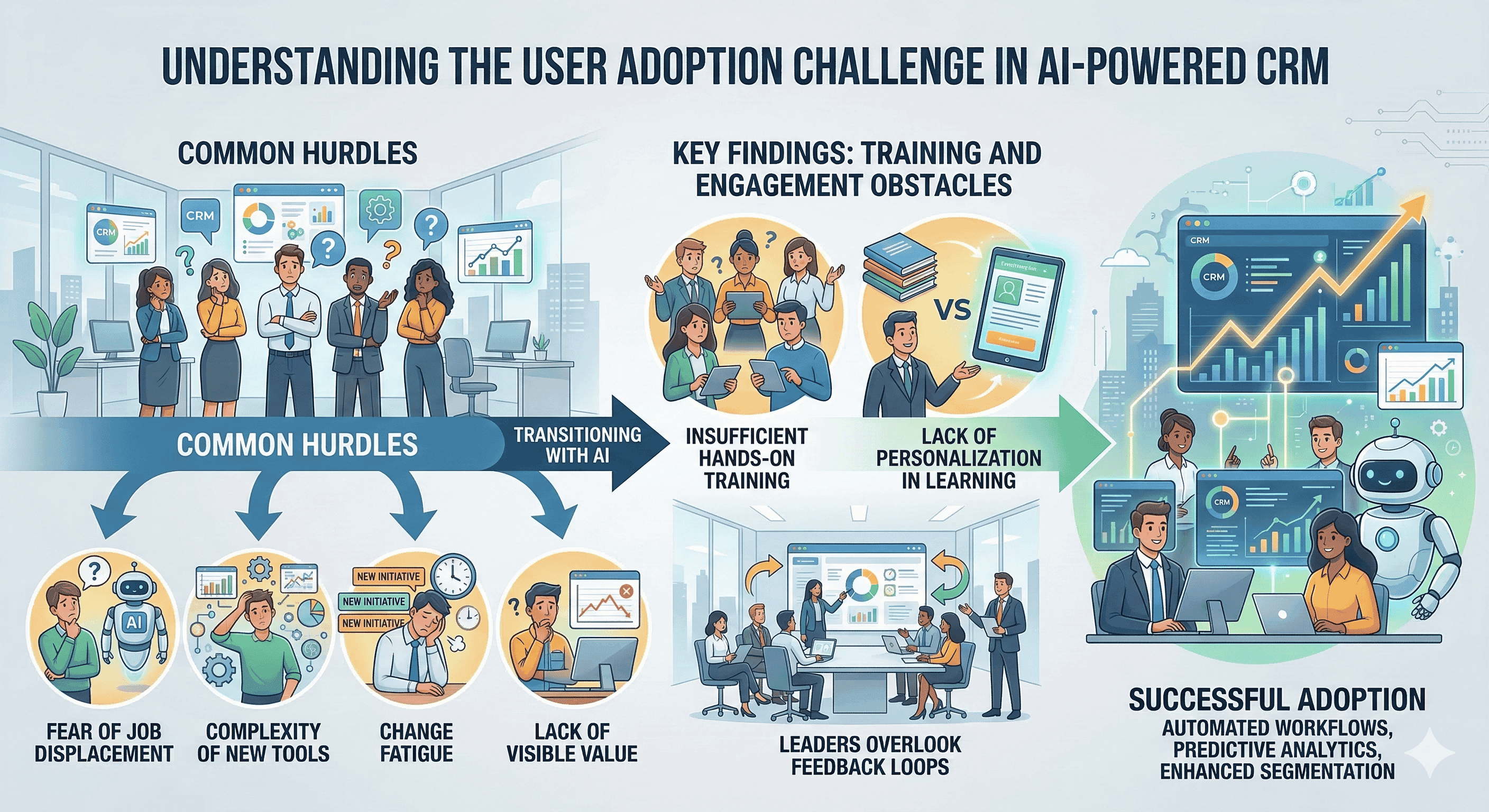
Integrating AI into CRM systems like Salesforce or Microsoft Dynamics represents a paradigm shift. While AI promises impressive capabilities, automated workflows, predictive analytics, enhanced segmentation, it’s natural for users to feel uncertainty. Common hurdles include:
- Fear of Job Displacement: Employees may worry that AI will automate their roles out of existence.
- Complexity of New Tools: AI-powered features can feel overwhelming without proper context or training.
- Change Fatigue: Teams may have experienced multiple digital initiatives with limited success, making them skeptical.
- Lack of Visible Value: If users can't see how AI-driven CRM workflows improve their daily activities, motivation drops.
Key Findings: Training and Engagement Obstacles
- Insufficient hands-on training limits user confidence.
- Lack of personalization in learning materials reduces relevance and retention.
- Leaders sometimes overlook feedback loops to monitor adoption and adjust strategies.
Effective Training Strategies for AI-Powered CRM Success
Drawing from OMI’s two decades in CRM integration, here are the pillars of a robust training approach for AI-powered user adoption:
1. Start with the Business Problem
- Anchor learning in real use cases relevant to each department, show how AI-powered CRM tools will address actual challenges (such as accelerating sales cycles or delivering more personalized marketing).
- Include managers in early training sessions to ensure leadership alignment and set a culture of enthusiasm.
2. Develop Role-Based Learning Paths
- Design training that reflects specific roles, Sales, Support, Marketing, Management, so each user receives actionable knowledge for their workflows.
- Utilize scenario-driven modules and foster collaboration through interactive workshops.
3. Emphasize Continuous Learning and Support
- Adoption is not a one-time event. Create ongoing training touchpoints, refresher sessions, open Q&A hours, and an accessible knowledge base curated for your CRM stack.
- Encourage user feedback and iterate on training based on real-world issues surfaced during rollout.
4. Leverage Data and Analytics for Engagement
- Track CRM activity logs and user engagement metrics to spot adoption gaps.
- Share data with end-users, helping them recognize how the platform streamlines tasks and strengthens customer relationships.
5. Foster a Culture of Experimentation
- Position AI-powered CRM features as collaborative partners, not replacements. Highlight quick wins and encourage exploration without repercussions for mistakes.
- Recognize and reward employees who advocate for and help grow adoption within peer groups.
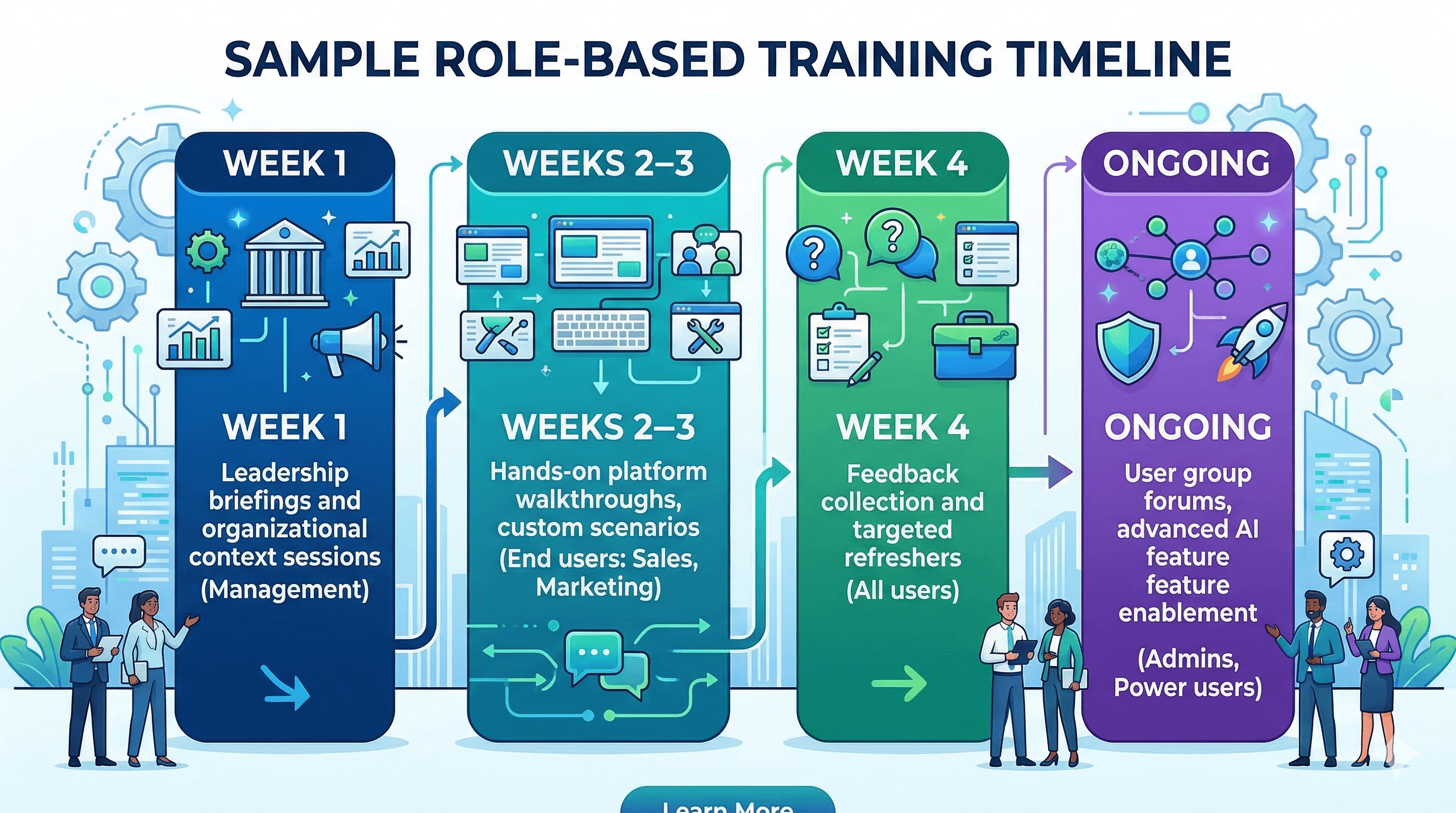
Sample Role-Based Training Timeline
- Week 1: Leadership briefings and organizational context sessions (Management)
- Week 2–3: Hands-on platform walkthroughs, custom scenarios (End users: Sales, Marketing)
- Week 4: Feedback collection and targeted refreshers (All users)
- Ongoing: User group forums, advanced AI feature enablement (Admins, Power users)
From Implementation to Results: Best Practices for Long-Term Adoption
- Involve Stakeholders Early: Bypass resistance by giving stakeholders visibility into the CRM planning and pilot process.
- Align with Business Objectives: Keep training outcomes tied to tangible business KPIs (lead response time, case resolution rates).
- Utilize Managed Services: Tap into managed CRM service providers for tailored onboarding, best practices, and scaled support. OMI’s managed services model ensures a blend of technical horsepower and hands-on user enablement in Salesforce and Microsoft Dynamics environments.
- Measure and Refine: Use analytics to monitor adoption, track learning milestones, and proactively adjust your approach.
Insights from the Field: What We’ve Learned
Over 25+ years, we’ve seen AI-powered CRM transitions succeed where organizations embrace a partnership mindset. For example, we worked with a distribution company that, through iterative workshops and open dialogue between business users and IT, transformed initial skepticism into advocacy. Feedback from every user tier enabled us to refine automation rules, adjust training cadence, and ultimately deliver a solution where AI-driven insights became an integral part of daily routines, without overwhelming the workforce or disrupting core operations.
True digital transformation is achieved when users feel listened to, supported, and included in the journey. Combining business context, technical training, and user-centric culture is the winning strategy for CRM optimization.
Conclusion
AI-powered CRM systems offer tremendous potential, but fulfilling that potential demands more than just rolling out new features. Training strategies must be deeply personalized, iterative, and grounded in business value. By focusing on end-user engagement, leveraging managed services, and tracking outcomes, companies can not only adopt but thrive with AI-augmented CRM platforms like Salesforce and Microsoft Dynamics. For those seeking reliable expertise in CRM optimization, integration, and proactive AI consulting, OMI stands ready as a strategic partner for the journey ahead.
Ready to harness true value from your CRM investment? Connect with OMI for CRM managed services and tailored AI consulting.
Frequently Asked Questions (FAQs)
- How do AI-powered CRM features impact the daily work of my sales or support teams? AI streamlines repetitive tasks and provides data-driven recommendations, allowing teams to focus on high-value activities. Through role-based training, employees quickly see how AI makes their work more effective and less administrative, directly aligning their daily output with organizational goals.
- What’s the best way to roll out AI-powered CRM tools to minimize user resistance?
Success starts with transparent communication and leadership alignment. By involving stakeholders early and addressing concerns like data privacy or job displacement through explanation sessions, you replace "black box" fears with trust. OMI uses scenario-based training to build immediate confidence. - Does my team need to learn complex "prompt engineering" or coding?
Not necessarily. Modern platforms like Salesforce and Microsoft Dynamics are moving toward natural language interfaces. Training now focuses more on data literacy, learning how to interpret AI insights and guide AI agents, rather than technical programming. - What happens if our current CRM data is "messy"?
AI is only as effective as the data it consumes. Rolling out AI on poor data can actually increase resistance because the insights will be inaccurate. We recommend a Data Hygiene Audit to ensure your system is "AI-ready" before features are enabled, preventing the "garbage in, garbage out" cycle. - How do we measure user adoption and the "break-even" point for our investment?
We track "Time-to-Value" (TTV) by monitoring system usage, lead-to-close speeds, and user feedback. Most SMBs see a tangible shift in productivity within 3 to 6 months when they move beyond simple implementation to active, measured engagement. - How often should training be updated as AI technology evolves?
Because major CRM platforms release significant updates multiple times a year, we recommend a "Continuous Enablement" model. This includes quarterly feature spotlights and a living knowledge base rather than a one-time workshop, ensuring your team’s skills evolve with the software. - How do managed services like OMI support long-term AI success?
Managed services provide the technical horsepower and strategic oversight needed to keep pace with evolving platforms. OMI combines decades of CRM expertise with a managed service framework to provide tailored adoption plans, proactive data cleaning, and ongoing user education that maximizes your ROI.