What Are Leads in Salesforce? A Deep Dive Into Their Role and Lifecycle
February 23
CRM Configuration
Salesforce
Blogs

Leads in Salesforce form the lifeblood of any B2B or B2C sales ecosystem. If you have ever wondered why so many organizations obsess over lead data, the answer is simple: it's where potential revenue truly begins. At OMI, we have seen firsthand how a nuanced understanding and thoughtful handling of Leads in Salesforce can transform disconnected interest into structured, qualified sales opportunities, ultimately fueling sustainable business growth.
What Exactly Is a Lead in Salesforce?
A Lead in Salesforce is a raw, unqualified prospective customer, either an individual or an organization, that has expressed interest but is not yet associated with your existing Accounts or Contacts. Leads may enter from a variety of channels, such as web forms, marketing campaigns, trade show lists, or referrals. The core function of a Lead is to gather critical information: who they are, how to contact them, their company, and their specific interests or needs.
It’s tempting to treat Leads as low-value compared to existing customers. But from our experience optimizing CRM journeys, the quality, organization, and nurturing of your Leads directly correlate to downstream revenue conversion and accuracy in sales forecasting. Well-governed Leads position your teams to act proactively rather than reactively.
The Role of Leads: Why They Matter in Salesforce
Many organizations we support at OMI come to us underestimating the operational value of Leads. Salesforce Ben weighs in highlight the crucialness of lead routing and management referring to the evolving expectations and demands of customers alongside the complexity of their requirements. Here is why they matter:
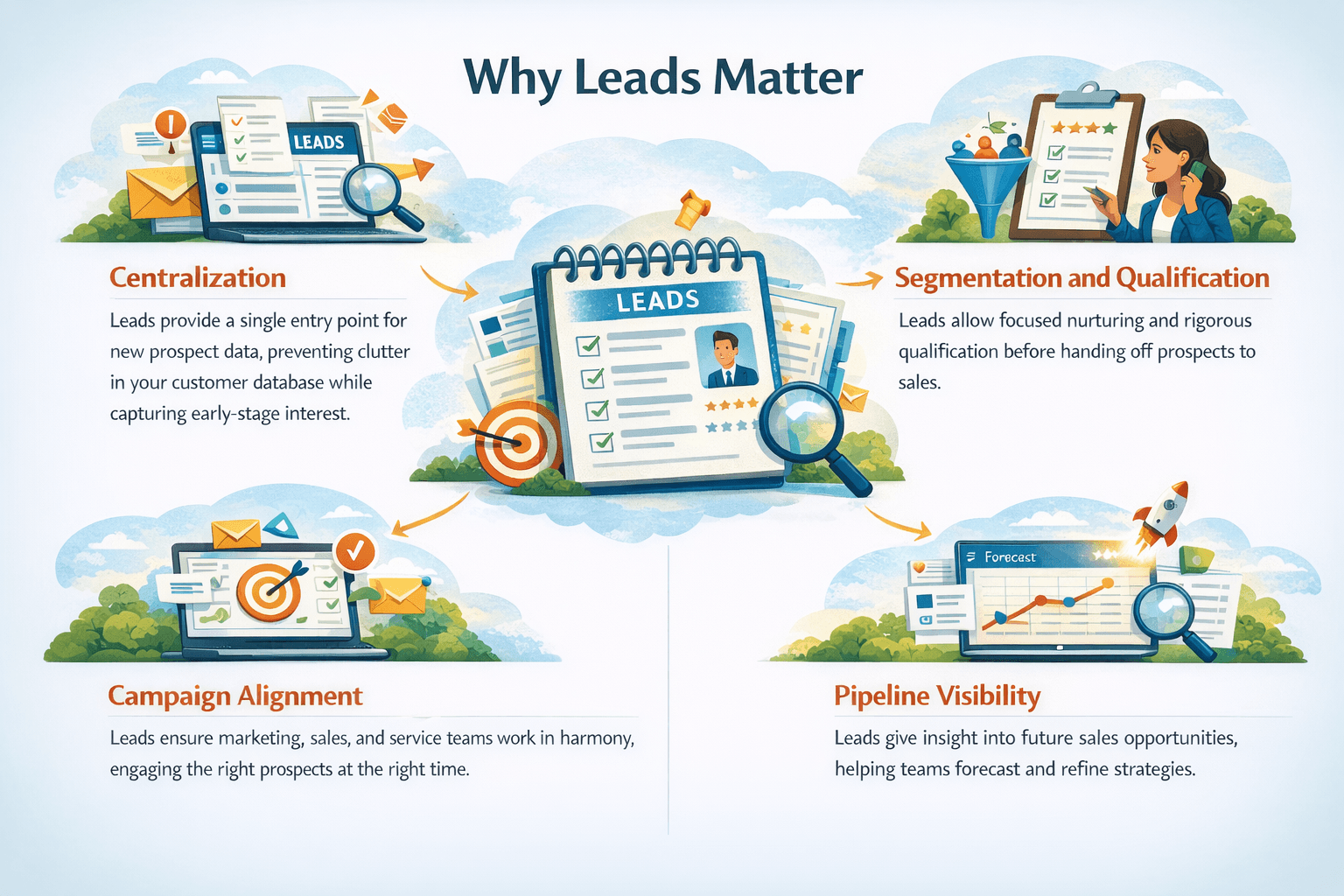
- Centralization: Leads provide a single entry point for diverse, sometimes messy prospect data. Without a Lead record, you risk cluttering your valuable customer database or missing the early stage signals of new business.
- Segmentation and Qualification: Leads are distinct from Contacts (individuals within known customer Accounts), enabling focused nurturing and rigorous qualification before handing off to sales teams.
- Campaign Alignment: By collecting leads in a dedicated object, your marketing, sales, and service departments avoid redundant outreach and ensure that every prospect is engaged with the right message at the right time.
- Pipeline Visibility: Leads, when handled correctly, provide insight into future sales opportunities, letting revenue teams forecast and refine their strategies with greater precision.
Salesforce Lead Lifecycle: From Raw Data to Revenue
“Lead management is a structured process that captures, tracks, and nurtures prospects through the sales cycle using CRM tools, helping you understand their behaviors and needs so you can convert them into customers.”- Salesforce on the value of lead management. At OMI, we guide organizations through the stages of the Salesforce Lead lifecycle, aligning each phase with their business and growth objectives. Let’s break down this journey in detail:
1. Lead Capture
Leads are created through multiple funnels, including web-to-lead forms, manual input, third-party integrations (like Outlook or marketing automation tools), and list imports. Automation (such as integrated web forms) not only expedites capture, but also ensures consistency and reduces manual errors. If you’re using platforms like Salesforce Marketing Cloud, seamless integration can auto-populate Lead records in real-time and improve your data quality from day one.
2. Lead Nurturing
Once captured, nurturing is critical. Our recommendation is to personalize communications based on source, interest area, and scoring. Effective nurturing in Salesforce includes configuring lead assignment rules, tracking email engagement, and establishing lead scoring based on observed behaviors. For instance, visiting key web pages or engaging with high-value content should increase a Lead’s score.
3. Lead Qualification
The next phase is qualification, where sales development reps or marketers determine if the Lead is worth further pursuit. This often involves discovery calls and following established qualification criteria like Budget, Authority, Need, and Timeline (BANT). Only once a Lead meets your qualification standards is it marked as ready for conversion. Unqualified leads are typically recycled for future nurturing, ensuring no opportunity is completely lost.
4. Lead Conversion
When a Lead is considered sales-ready, Salesforce enables a one-click conversion process. The system transforms the Lead record into a Contact, links it to an existing or new Account (organization), and may create an Opportunity if there’s an active deal. Data mapping is automated, ensuring that all critical information is preserved during the transition, minimizing the risk of data silos.
5. Post-Conversion: From Opportunity to Customer
Converted Leads move into Salesforce’s structured CRM model. The Opportunity created at conversion is now managed in the sales pipeline, complete with forecasting, activity tracking, and stage progressions. Contacts and Accounts become ongoing sources of communication, upsells, and support.
How Salesforce Leads Differ from Contacts, Accounts, and Opportunities
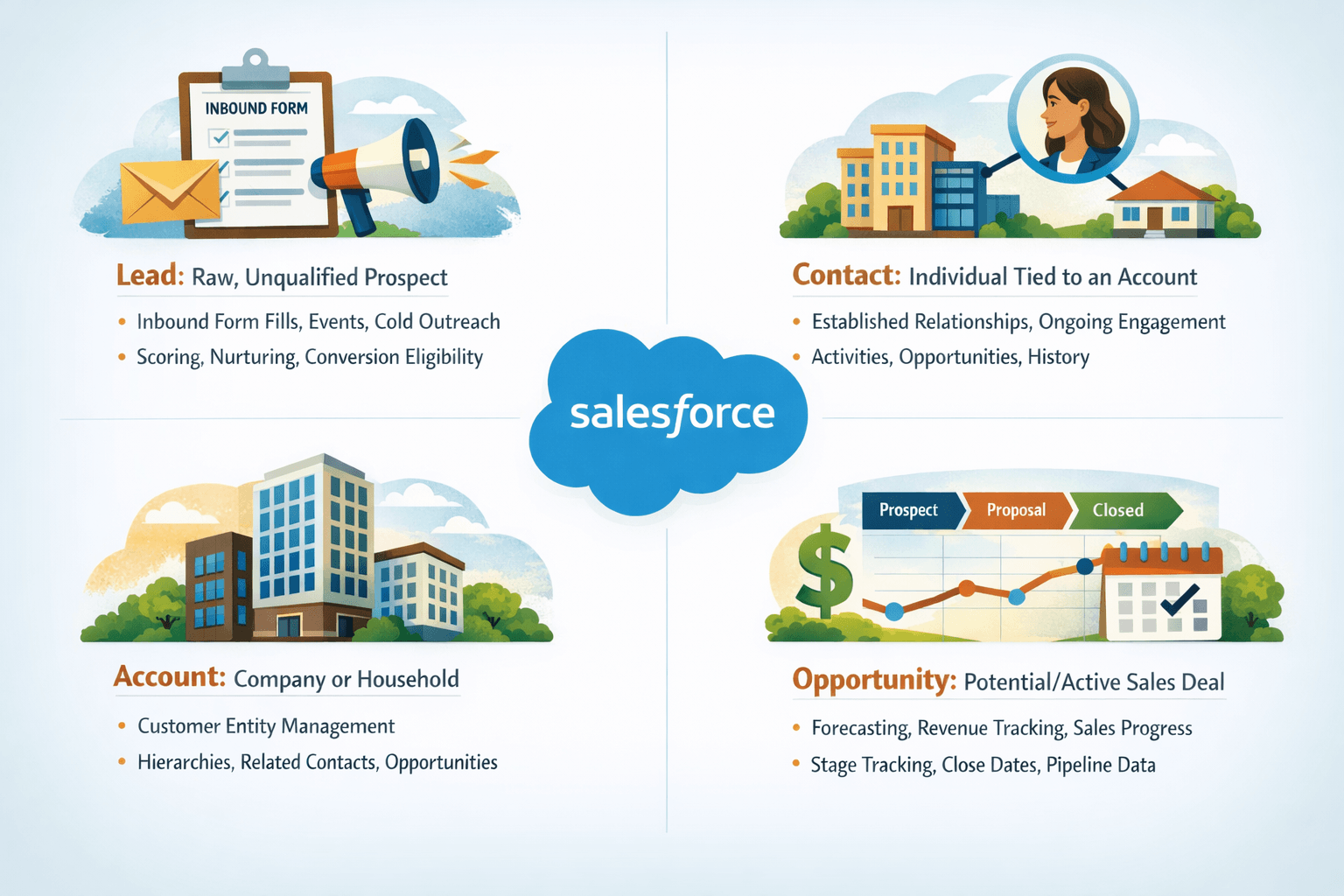
Below is a comparison of Salesforce's four primary objects and their key roles:
- Lead: Raw, unqualified prospect. Use case: Inbound form fills, events, cold outreach. Key features: Scoring, nurturing, conversion eligibility.
- Contact: Individual tied to an Account. Use case: Established relationships, ongoing engagement. Key features: Activities, opportunities, history.
- Account: Company (or household for B2C). Use case: Customer entity management. Key features: Hierarchies, related Contacts, Opportunities.
- Opportunity: Active or potential sales deal. Use case: Forecasting, revenue tracking, sales progress. Key features: Stage tracking, close dates, pipeline data.
Best Practices for Salesforce Lead Management
Drawing on over 25 years of CRM focus at OMI, we offer a set of actionable best practices to help organizations get the most from their Salesforce Leads:
- Implement Rigorous Data Hygiene: Deduplicate and standardize incoming leads regularly. Regular weekly reviews prevent data bloat and confusion downstream.
- Automate Assignment: Set clear, actionable rules to direct leads to the right owner or team instantly. This ensures that no lead sits idle and response times are consistently minimized.
- Integrate with Marketing Automation: Connect your marketing tools for seamless nurture campaigns. Track engagement directly in Salesforce for a full view of your Lead journey.
- Score and Prioritize Intelligently: Assign scores based on behaviors, demographics, or source. Prioritizing leads lets sales teams focus their energy where it counts most.
- Move Fast on Qualified Leads: Set up prompt notifications and streamlined conversion flows so qualified leads move to sales ownership without unnecessary delays.
- Leverage Reporting: Use dashboards to monitor Lead aging, conversion rates, and campaign ROI to continually refine your process.
- Consider Managed Services for Scale: For growing businesses or teams seeking to maximize their Salesforce investment, outsourcing administration and optimization to experts can ensure a leading-edge, future-proof solution.
Insights from the Frontlines: What OMI Has Learned
One unique perspective we have developed at OMI is that Lead management is not only a process but a cultural habit. Companies that value every incoming lead, regardless of origin or perceived value, tend to build stronger, more consistent pipelines. For example, some of our most successful clients have simply committed to acting on every lead within 24 hours, whether by automated communication or personal outreach. This discipline, when paired with the right Salesforce configuration, has a measurable impact on pipeline velocity and revenue predictability.
Why Process Matters: Aligning Salesforce Leads With Business Strategy
The most successful organizations embed their Lead management strategy within their overall business goals. At OMI, we don’t believe in a one-size-fits-all template. Instead, we listen and study your context, then tailor Salesforce’s Lead lifecycle (from assignment rules to campaign integrations) to ensure alignment with your sales funnel, resource bandwidth, and growth targets.
Ultimately, Lead management in Salesforce is as much about discipline and clarity as it is about technology. When structured thoughtfully, this process unlocks strategic insights and creates a repeatable path to revenue.
Ready to Elevate Your Salesforce Lead Strategy?
If you are looking to optimize the way your organization handles Salesforce Leads, from capture and qualification to conversion and beyond, our team at OMI is ready to share insights, best practices, and hands-on support. Our experience spans hundreds of successful Salesforce projects, giving us a lens for what drives measurable business results.
Connect with us today for a free consultation and discover how OMI can power your journey from raw leads to loyal customer relationships. Learn more about our Salesforce services and see what true CRM performance looks like for your business.
Frequently Asked Salesforce Lead Questions
- How do I know if my Salesforce Lead process is costing us revenue? If Leads sit untouched, follow-ups are inconsistent, conversion rates are low, or forecasting feels unreliable, your process may be leaking revenue. Poor routing, unclear qualification criteria, and lack of visibility into lead aging are common warning signs that your lifecycle needs refinement.
- Should I convert every Lead? No. Only convert leads that meet your qualification criteria. Otherwise, mark them as unqualified and recycle them for future campaigns.
- How quickly should we respond to new Leads? Speed directly impacts conversion. High-performing revenue teams respond within hours, not days, often committing to a 24-hour or faster response time. Automated assignment rules and real-time alerts in Salesforce help ensure no qualified Lead goes cold.
- How do you avoid duplicate data? Use Salesforce’s duplicate management tools at both capture and conversion stages. Regular data stewardship is essential.
- When should we bring in a Salesforce expert to optimize Lead management? If your conversion rates have plateaued, your data feels messy, or your marketing and sales teams aren’t aligned, it may be time for expert support. A strategic Salesforce partner can streamline automation, improve reporting, and align your Lead lifecycle with measurable revenue goals.
- What if my Leads are mostly unresponsive? Re-evaluate your sources, scoring, and nurturing tactics. Sometimes, a simple change in communication channel or sequence can improve results dramatically.
- Is lead scoring necessary for growing business? Yes, especially as lead volume increases. Lead scoring helps prioritize sales-ready prospects based on engagement, behavior, and fit. Without it, sales teams risk chasing low-value prospects while high-intent buyers lose momentum.