Enabling Seamless CRM Migrations: Minimizing Downtime and Maximizing User Adoption
January 05
CRM Configuration
Blogs

CRM migrations are critical initiatives for organizations aiming to level up customer engagement, modernize workflows, and unlock the benefits of platforms like Salesforce and Microsoft Dynamics. Yet, the stakes are high, because every hour of downtime can lead to operational inefficiency, revenue loss, and frustrated teams. At OMI, we’ve guided countless small and medium sized organizations through the complex territory of CRM migration, implementation, and management. From this firsthand experience we know: seamless migrations aren’t just about technology. They’re about people, process, and precision.
Understanding the Core Challenge: Why CRM Migrations Are Difficult
For IT decision-makers and admins, CRM migrations present a cross-functional, high-risk project. Let’s clarify the pain points that most organizations will face:
- Data Integrity Risks: Transferring vast and complex datasets without loss or corruption is a non-negotiable requirement.
- Downtime Impact: Even a short outage can cause sales teams and support departments to grind to a halt.
- User Resistance and Adoption Issues: New systems can be perceived as threats if not championed and supported from day one.
- Integration and Workflow Disruption: Legacy tools, connected apps, and business logic must be preserved or improved upon in the new environment.
The OMI Approach: Strategies for Minimizing Downtime and Maximizing User Adoption
Our philosophy is simple: Successful migrations combine robust technology with human-centered planning. Here’s how we break it down:
1. Business-Driven Planning
- We work collaboratively with stakeholders to document workflows, customizations, regulatory requirements, and success metrics for CRM integration.
- Critical processes are mapped out to ensure no business intelligence or automation capability is lost in transition.
2. Data Stewardship and Quality Assurance
- Prioritize cleanliness and structure by auditing and deduplicating legacy data well before migration begins.
- Automate validations and establish clear data mapping policies to maintain CRM optimization and reporting accuracy.
Potential Data Issues and Prevention Approaches typically include:
- Duplicate Contacts: Automated deduplication scripts & manual review
- Corrupt File Attachments: File integrity checks during staging
- Inaccurate Mapping: Crosswalk documentation and sandbox testing
3. Minimizing Downtime through Phased Rollouts
- Deploy in stages: pilot departments first, organization-wide later.
- Utilize sandbox and mirror testing to anticipate issues before go-live.
- Schedule final cutover for low-activity periods, minimizing impact.
4. Proactive Change Management to Foster Adoption
- Involve end users early, pool feedback on pain points and desired improvements.
- Offer hands-on workshops and just-in-time microlearning modules tailored by department.
- Empower internal champions to advocate for best practices within business units.
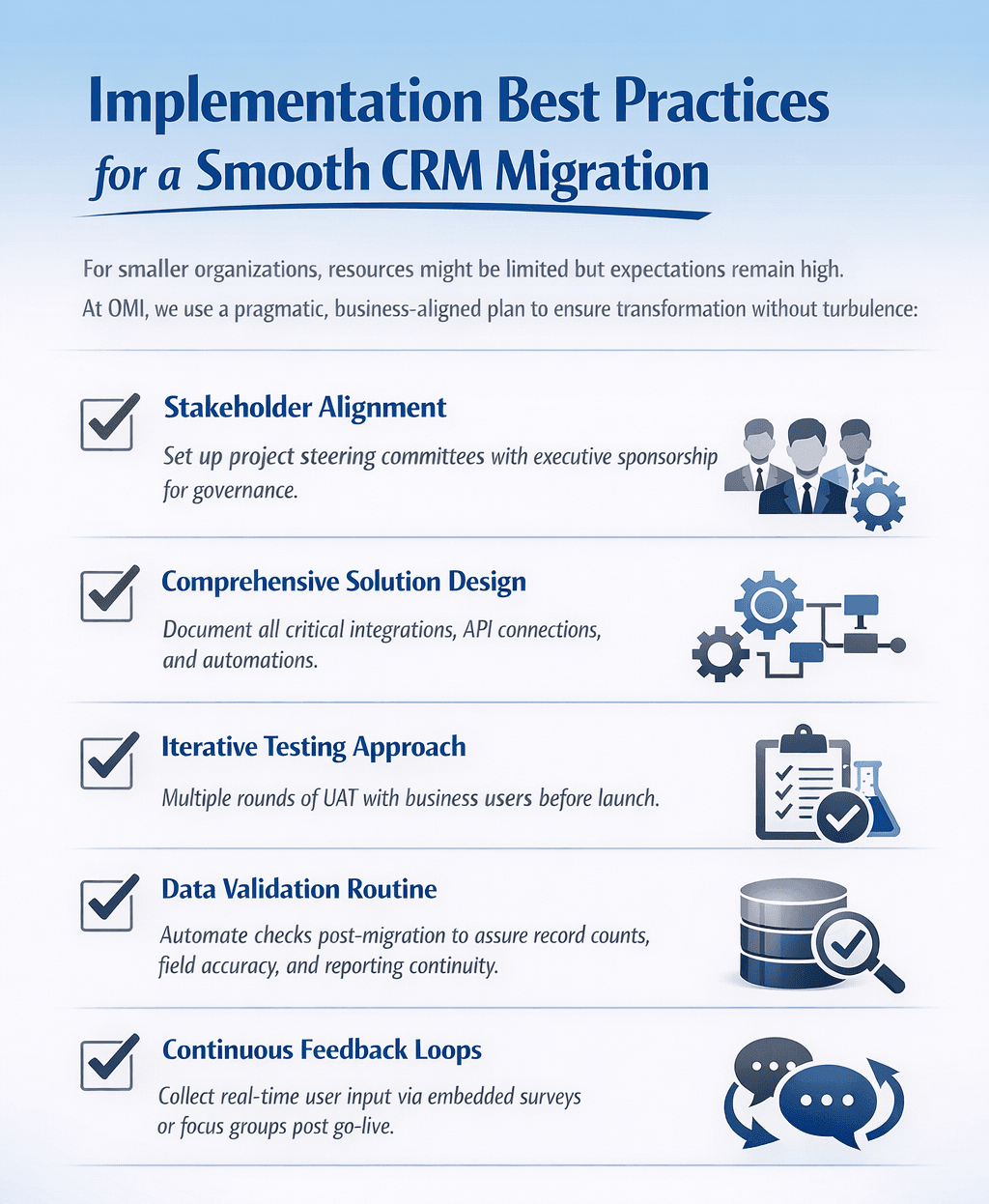
Implementation Best Practices for a Smooth CRM Migration
For smaller organizations, resources might be limited but expectations remain high. At OMI, we use a pragmatic, business-aligned plan to ensure transformation without turbulence:
- Stakeholder Alignment: Set up project steering committees with executive sponsorship for governance.
- Comprehensive Solution Design: Document all critical integrations, API connections, and automations.
- Iterative Testing Approach: Multiple rounds of UAT with business users before launch.
- Data Validation Routine: Automate checks post-migration to assure record counts, field accuracy, and reporting continuity.
- Continuous Feedback Loops: Collect real-time user input via embedded surveys or focus groups post go-live.
Real-World Lessons: What Drives CRM Migration Success?
With nearly three decades in CRM consulting and managed services, we’ve distilled several lessons that small and medium enterprises should prioritize:
- Invest in Knowledge Transfer: If end users are not empowered from the start, the risk of shadow IT and process workarounds increases.
- Plan for Future Growth: Use migration as an opportunity to clean up technical debt and set the stage for future Salesforce or Microsoft Dynamics configurations.
- Monitor User Engagement: Leverage dashboards and CRM analytics to spot usage drop-offs early and enable targeted outreach and retraining.
Conclusion: Building a Seamless CRM Migration Roadmap
CRM migration is much more than a technical exercise, it’s a business transformation journey. When you prioritize strategic planning, data quality, phased implementation, and user buy-in, you minimize risk and set your teams up for long-term success. Whether you’re relocating to Salesforce Cloud or unifying platforms, the methods highlighted here form the backbone of a migration that preserves business continuity while delighting users.
If you’re ready to elevate your CRM deployment strategy, OMI offers expert consulting, Salesforce integration, and managed services that deliver real results for small and mid-sized organizations. Learn more about building smarter futures with OMI.
Frequently Asked Questions: CRM Migration, Downtime, and User Adoption
- How does OMI minimize downtime during CRM migrations?
Our approach includes pre-migration sandbox testing, staged rollouts, and migration scheduling during low-traffic periods to ensure business operations keep moving forward. - What steps does OMI take to secure data quality during migration?
We emphasize rigorous data audits and validation routines, mapping legacy data carefully and utilizing automation to reduce manual errors. - How does OMI drive higher user adoption post-migration?
We prioritize proactive change management with targeted training, clear communication, and the creation of internal champions who foster a culture of support for the new system. Engagement is measured and supported through feedback loops. - Can OMI support our unique integrations and automations?
Yes. As certified Salesforce and Microsoft Dynamics partners, OMI designs, tests, and implements complex integrations with in-depth documentation. Custom automations receive the same level of care, ensuring business logic is never lost in migration. - How do I start the migration process with OMI?
Reach out to discuss your requirements. We initiate each engagement with a kick off meeting to clarify business challenges and set project objectives for CRM optimization and digital transformation.