How to Leverage Managed Services Azure and AWS Tools for Cloud Cost Optimization: Resource Tagging, Autoscaling & FinOps Best Practices
November 24
Cloud
Administration
Blogs
The promise of the cloud agility, speed, and scalability often collides with the hard reality of unexpected expenses and underused resources. Having worked alongside organizations at every stage of their cloud journey, we at OMI know just how critical it is to translate that promise into concrete business value. True cost optimization in the cloud isn’t just a dashboard metric but a strategy baked into every process, every tool, and every decision. In this article, we’ll walk through how you can harness the power of managed Azure and AWS services for cloud cost optimization leveraging resource tagging, autoscaling, and FinOps best practices to turn your cloud into a business advantage, not a blank check.
It All Begins with Clarity: Resource Tagging
For most mid-sized and large organizations, the complexity of a cloud environment rivals legacy IT sprawl except it happens at accelerative speed and scale. Resource sprawl isn’t just confusing; it’s expensive. That’s where resource tagging proves invaluable. It’s more than just best practice; tagging is the compass by which you steer complex, multi-cloud investments toward financial control.
What is Resource Tagging? Assigning structured metadata (such as cost center, environment, project, or owner) to every cloud resource as it’s provisioned.
Why it matters: When tags are enforced and standardized, you create a real-time, granular map of cloud spend, so that costs can be traced and justified per project, per department, even per feature launch.
Azure Approach: Use Azure Policy to enforce consistent tagging requirements across new and existing resources.
AWS Approach: Leverage Tag Editor and Resource Groups, tying into AWS Cost Explorer for rich, tag-based reporting.
If you’re implementing managed services or integrations for clients as we frequently do this foundation means every dollar spent on infrastructure is visible and actionable. To get the most out of tagging, invest upfront in defining a tagging taxonomy that matches business priorities, and automate tags as part of your infrastructure-as-code or provisioning pipelines.
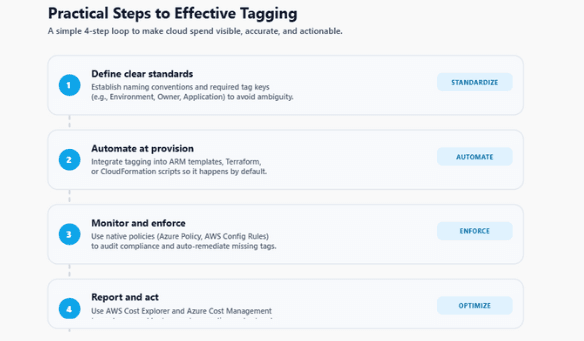
Practical Steps to Effective Tagging
- Define clear standards: Establish naming conventions and required tag keys (e.g., Environment, Owner, Application) to avoid ambiguity.
- Automate at provision: Integrate tagging into ARM templates, Terraform, or CloudFormation scripts so it happens by default.
- Monitor and enforce: Use native policies (Azure Policy, AWS Config Rules) to audit and enforce compliance and remediate missing or inconsistent tags automatically.
- Report and act: Rely on native tools AWS Cost Explorer, Azure Cost Management to analyze spend by tag, uncover anomalies, and take action predictively.
Scaling Smarter: Autoscaling as Cost Control
It’s tempting to treat cloud capacity as infinite but budgets are not. Manual overprovisioning, buying for peaks that rarely come, unnecessarily inflates spend. Enter autoscaling: the practice of programmatically scaling cloud resources up and down with demand. Using this capability intelligently is the difference between cloud agility and bloat.
- AWS Autoscaling Groups: Monitor utilization metrics via CloudWatch; define policies for adding/removing EC2s as usage patterns change.
- Azure Virtual Machine Scale Sets: Automatically adjust the number of instances based on CPU, memory, or even custom metrics ideal for both predictable and burst workloads.
In a real-world scenario, this is not just about scripts it’s about understanding your business’ actual demand curves, building buffer into your rules so end users never feel the pinch of resource shortage, and tuning as workloads evolve.
Deploying Effective Autoscaling
- Define clear min/max boundaries for each workload (avoid the ‘runaway’ scale-up!)
- Implement cooldown periods avoid oscillations by waiting before the next scale event
- Test with simulated traffic stress test performance, cost, and user impact before putting into production
- Integrate with tagging so you can measure cost savings directly by autoscaled resource sets
FinOps: Operationalizing Cloud Cost Optimization
Tagging and autoscaling are foundational, but true optimization is cultural. FinOps, or Financial Operations, is where financial accountability and technical execution finally meet. FinOps is widely recognized as a cultural framework for maximizing cloud value, a definition led by the FinOps Foundation’s Technical Advisory Council that emphasizes shared accountability between engineering, finance, and business teams. At OMI, we see FinOps not just as a buzzword, but as a discipline embedded across teams the bridge that links technology, finance, and executive strategy.
Three Crucial FinOps Moves
Right-Sizing and Rightsourcing
- Continuously review utilization: Use tools like Azure Advisor and AWS Compute Optimizer to receive actionable recommendations for down-sizing or eliminating idle resources.
- Automate remediation: Bake these recommendations into regular sprints or reviews don’t leave potential savings to manual guesswork.
Reserved and Committed Capacity Planning
- Azure Reserved VM Instances/AWS Savings Plans: Analyze baseline capacity needs and commit to 1-3 year reservations for significant savings pair with autoscaling for spikes.
- Regularly re-evaluate: Make it routine to reassess reserved vs. on-demand coverage as business priorities and forecasted usage changes.
Storage Lifecycle Optimization
- Match storage class to usage: Transition infrequently used files to lower-cost storage S3 Infrequent Access or Glacier for AWS, Cool/Archive for Azure.
- Automate with policies: Use lifecycle policies and periodically audit buckets/containers for forgotten data.
The OMI Approach: Orchestrating Cloud Optimization for Lasting Business Impact
Cost optimization isn’t a one-off exercise; it’s an operating model. At OMI, we build that muscle with clients by always starting with a discovery workshop mapping not only workloads and technical architectures, but also the business objectives and budget owners behind each deployment. We know that getting tagging, automation, and FinOps workflows right upfront saves time and dollars down the line.
Our hands-on experience in multi-cloud scenarios integrating Salesforce with Azure, running PowerBI analytics on AWS data lakes, or automating DevOps pipelines gives us unique perspective. We’ve seen firsthand how a single missed tag, an ill-planned scale set, or a forgotten storage bucket can undermine months of great work. That’s why we go deep, not just wide, in every engagement.
What Does This Look Like in Practice?
Managed FinOps: Establish clear governance policies including tagging standards and cost anomaly alerts which we review together at regular intervals.
Automation at Every Level: Infrastructure provisioning, tagging, scaling, and reporting are automated to minimize human error and manual effort.
Transparent Reporting: Set up dashboards segmented by custom tags so business units can see, in near real-time, how their decisions impact spend and performance.
Continuous Reassessment: We know that business priorities change. Regular optimization reviews (quarterly at minimum) ensure that what worked yesterday is still fit for purpose today.
Key Takeaways for Your Cloud Optimization Journey
- Start with a strong tagging foundation invest in standards, automation, and enforcement upfront to avoid headaches later.
- Implement autoscaling policies tailored not just to technical needs, but real-world demand curves evident in your business.
- Embed FinOps culture across technology and finance regular reviews, shared dashboards, and actionable optimization cycles are as important as the tools themselves.
- Partner with experts who don’t just understand Azure and AWS tooling, but how these map to your business outcomes. Managed service providers should be an extension of your team not just a cost center, but a value multiplier.
Frequently Asked Questions (FAQ)
- What is cloud cost optimization, and why does it matter?
Cloud cost optimization is the practice of ensuring that cloud resources are provisioned, right-sized, and used efficiently to maximize business value. It matters because the ease of spinning up resources in Azure and AWS often leads to overspending, underutilization, and unclear ownership unless guardrails are in place.
- How does resource tagging improve cost visibility?
Resource tagging provides structured metadata such as owner, environment, project, or cost center—that allows teams to trace spend at a granular level. With consistent tagging, organizations can clearly understand who is using what, identify waste, and align cloud spend directly to business initiatives.
- What happens if resources aren’t tagged properly?
Poor tagging results in inaccurate reporting, unassigned costs, and inefficient decision-making. Teams spend excessive time tracing ownership, and financial leaders lose clarity on true investment levels across products, environments, or departments.
- How does autoscaling reduce cloud costs?
Autoscaling automatically adjusts compute capacity based on real-time demand. By scaling down during off-peak times and up during high-load periods, organizations avoid paying for unnecessary idle capacity while maintaining performance and reliability.
- Is autoscaling difficult to implement?
Not when done correctly. Both AWS and Azure provide native autoscaling tools, Auto Scaling Groups and Virtual Machine Scale Sets, that can be automated, tested, and tuned based on actual demand curves. The key is defining smart boundaries, cooldown periods, and monitoring rules.
- What is FinOps, and how does it support optimization?
FinOps is a cross-functional discipline that brings finance, engineering, and leadership together to manage cloud spend with shared accountability. It turns optimization from a one-time task into an ongoing operational model with continuous oversight, reporting, and iterative improvement.
- Can I implement cloud cost optimization without a managed services partner?
Yes, but it often requires significant time, expertise, and alignment across teams. A managed partner like OMI accelerates the process by establishing best practices, automating tagging and scaling, integrating cost governance, and providing ongoing optimization reviews.
- Are reserved instances or savings plans worth it?
For workloads with predictable demand, absolutely. Azure Reserved Instances and AWS Savings Plans can reduce compute costs significantly (often 30–60%+), especially when paired with autoscaling to handle variable spikes.
- How often should cloud environments be reviewed for optimization?
At minimum, quarterly. However, fast-moving organizations typically review monthly or continuously as part of a FinOps practice, since workloads, demand patterns, and business priorities shift frequently.
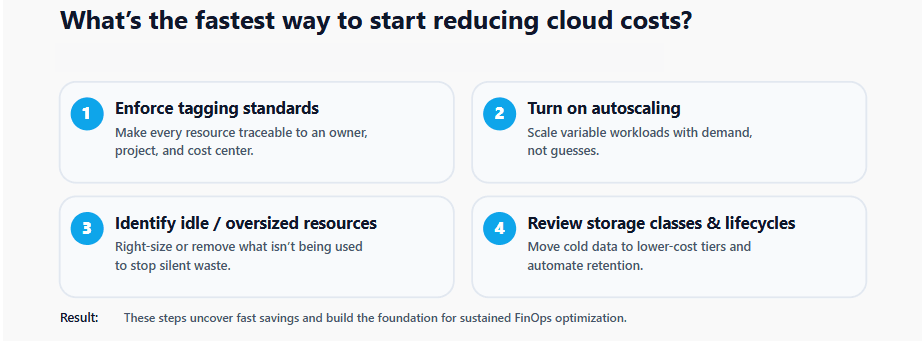
- What’s the fastest way to start reducing cloud costs?
Begin with the fundamentals:
- Enforce tagging standards
- Turn on autoscaling for variable workloads
- Identify idle or oversized resources
- Review storage classes and lifecycle policies
These steps often uncover immediate savings and lay the groundwork for sustained optimization.
Let’s Realize Smarter Futures Together
If your organization is ready to see concrete, measurable results from your Azure, AWS, or hybrid cloud investments, our team at OMI is here to help you architect, optimize, and manage this journey. We take a partnership-first approach, fusing expertise in managed services, CRM, data analytics, and digital transformation into every project. Reach out and discover how we can help you master cloud cost optimization and unlock business agility right where it matters most.