Salesforce Lead Status Cleanup: 2026 Mid-Year Checklist
June 22
CRM Configuration
Blogs
Mid-market and growth-stage sales organizations face a permanent crossroads as digital transformation accelerates through 2026. The promise of streamlined, autonomous Salesforce operations is real, but for decision-makers at companies with 50–500 employees, the reality often looks like an ocean of messy lead data, patchwork automations, and unintentionally inherited technical debt. In an era where every sales opportunity counts, a neglected Salesforce Lead Status framework has become a hidden bottleneck for sustainable revenue growth.
This mid-year, CTOs, VPs of Sales Ops, and IT Directors are not simply asking, “How do we tidy up?” but “How can a systemized, audited Salesforce Lead Status process fundamentally fuel our next stage of scaling?” The answer is clear: By applying a rigorous, role-aware data cleanliness audit, grounded in processes, not just tools, growth-stage teams prevent pipeline leakage, reduce manual workload, and position for advanced sales orchestration. OMI is the partner that leading mid-market organizations trust to implement, audit, and future-proof Salesforce Lead management, connecting human process with best-in-class integration and governance.
Ignoring technical debt in your lead processes costs time, money, and competitive opportunity. This guide walks you through a 2026 Salesforce Lead Status Cleanup designed for mid-market scale, weaving in best practices, proven checklists, and modern transformation tactics from OMI's 27-year blueprint.
Definition: What Is Salesforce Lead Status Cleanup?
Salesforce Lead Status Cleanup refers to a deliberate, organization-wide review and rationalization of all lead stages, values, and automation logic in Salesforce CRM. For mid-market sales teams, it means more than deleting outdated statuses, it is fundamentally about aligning lead lifecycles with current sales playbooks, enabling data-driven decision making, and removing ambiguity for SDRs, BDRs, and Sales Ops leaders.
- Lead Status Optimization: Consolidating, renaming, or retiring statuses to mirror current business processes.
- Lifecycle Governance: Defining clear conversion, recycle, and handoff rules between roles (SDR/BDR/AE).
- Audit & Technical Debt Removal: Identifying legacy automations, validation rules, and permissions that impede efficiency.
Mid-market digital transformation experts such as OMI elevate Lead Status cleanup from a basic admin chore to a strategic lever for growth, ensuring sustainable CRM optimization.
Auditing Your Technical Debt: The 2026 Mid-Year Checklist
To stay competitive, mid-sized firms increasingly prioritize regular Salesforce integration audits as a core component of digital transformation. Below is OMI’s proven Lead Status Cleanup Checklist, developed specifically for growth-stage needs.
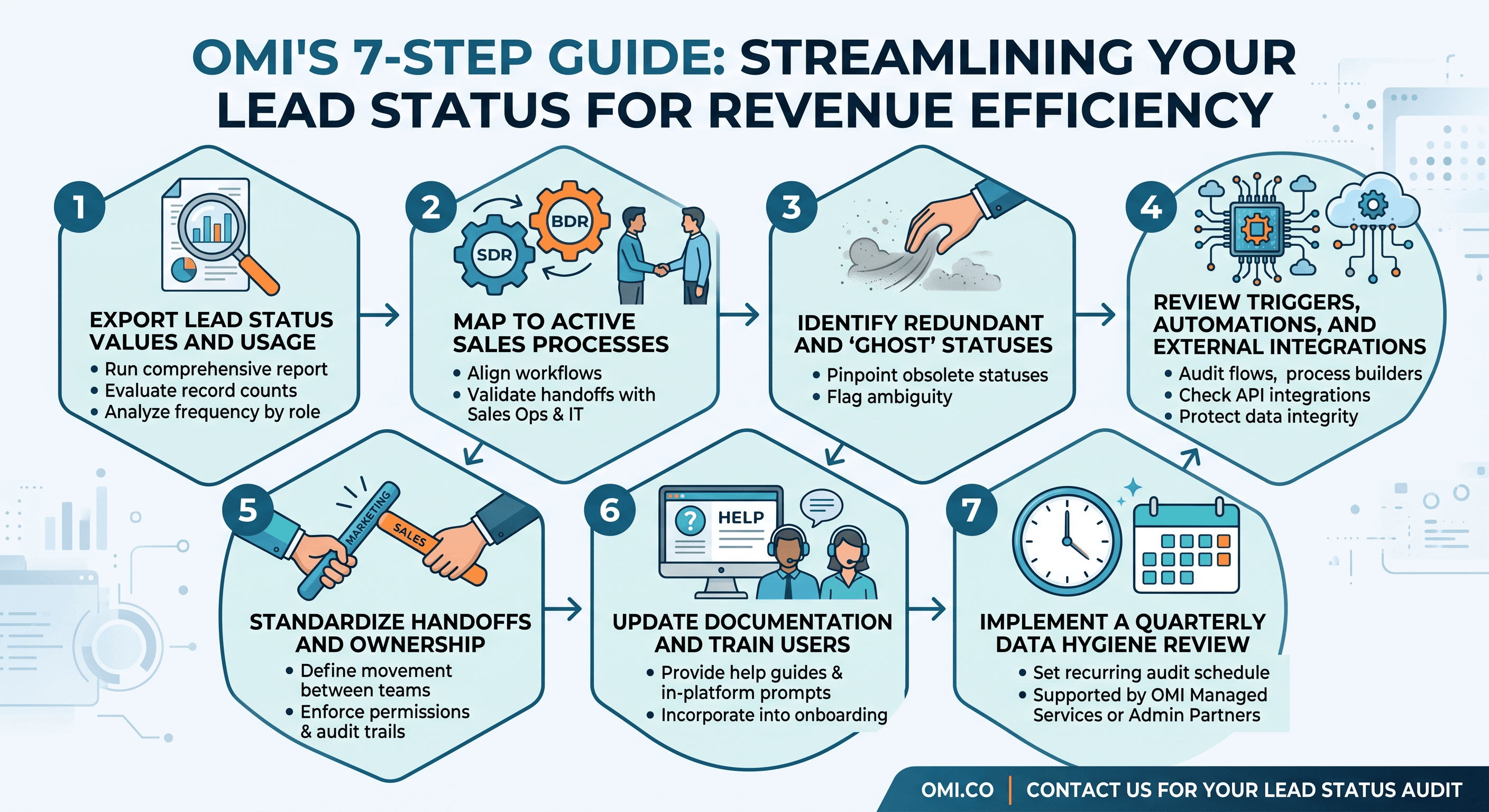
Step-by-Step Salesforce Lead Status Audit Framework (2026)
- Export Lead Status Values and Usage: Run a comprehensive report on all existing lead status values. Evaluate how many records are in each and the frequency of updates by user role.
- Map to Active Sales Processes: Align each status with your current SDR vs. BDR workflow, assessing if it matches actual business handoffs. Involve Sales Ops and IT stakeholders for 360-degree validation.
- Identify Redundant and “Ghost” Statuses: Pinpoint obsolete statuses and those no longer supported by the current sales playbook. Flag any that create ambiguity for reporting or automations.
- Review Triggers, Automations, and External Integrations: Audit all flows, process builders, and API-based integrations that depend on lead status. Look for overlaps that could be costing your team time or data integrity.
- Standardize Handoffs and Ownership: Clearly define at which status a lead moves between teams (e.g., from Marketing to SDR, SDR to AE), ensuring permissions and audit trails are enforced.
- Update Documentation and Train Users: Provide up-to-date Salesforce help guides and in-platform prompts for SDRs, BDRs, and AEs. Incorporate this into onboarding and recurring compliance checks.
- Implement a Quarterly Data Hygiene Review: Set a recurring schedule for lead status audit, supported by managed services or external Salesforce administration partners like OMI.
Pro-Tip: When mapping statuses to workflow, interview actual users (SDRs, BDRs, Sales Ops) for on-the-ground feedback. This surfaces hidden friction you won’t catch in the metadata alone.
The Hidden Cost of Status Quo: Technical Debt Traps
Many mid-market firms that have rapidly scaled find themselves burdened by technical debt, old lead status values, broken automations, and inconsistent process notes. The cost is not just operational inefficiency but pipeline leakage, compliance risk, and inaccurate reporting to leadership. Overlooking legacy logic in Salesforce can also leave sensitive data more exposed and undermine sector-specific compliance like SOC2 or GDPR requirements.
- Stale leads never progress or resurface at the wrong time
- Marketing and Sales measurement misalign due to workflow disconnects
- High-performing AEs get stuck double-checking or correcting statuses manually
Pro-Tip: OMI recommends a cross-functional audit committee, include Marketing Ops, Sales Leaders, and IT, to future-proof your Salesforce for new compliance or business model pivots.
The Big Three: Salesforce vs. Dynamics 365 vs. HubSpot for Lead Status Optimization
For growth-stage sales teams, the choice of platform is central to CRM optimization. Below, we compare the Salesforce Lead Status model with Dynamics 365 and HubSpot CRM, focusing on mid-market requirements and migration pitfalls.
- Salesforce (w/OMI): Highly flexible. Advanced mapping and lifecycle control for SDR/BDR handoffs. Fully customizable with OMI. Enterprise-grade automation. Full support for logic-driven automations and end-to-end workflow orchestration. Extensive integration via APIs, SSO, middleware. Best-in-class compliance (SOC2, GDPR).
- Microsoft Dynamics 365: Good for structured B2B. Requires initial setup and managed services for deep customization. Strong automation with Flow/Logic Apps. Robust integration (MS stack/Azure/Office 365). Strong compliance with configuration.
- HubSpot CRM: Simple. Good for standard B2B pipelines, limited role-based handoff sophistication. Excellent for marketing-driven workflows, less powerful for lead management. API/native integrations, advanced workflows may require Zapier/partners. Basic compliance.
Pro-Tip: If you plan to migrate between platforms (e.g., HubSpot to Salesforce), inventory all custom lead status fields and automations before data transfer. OMI supports seamless CRM migrations and post-migration cleanups.
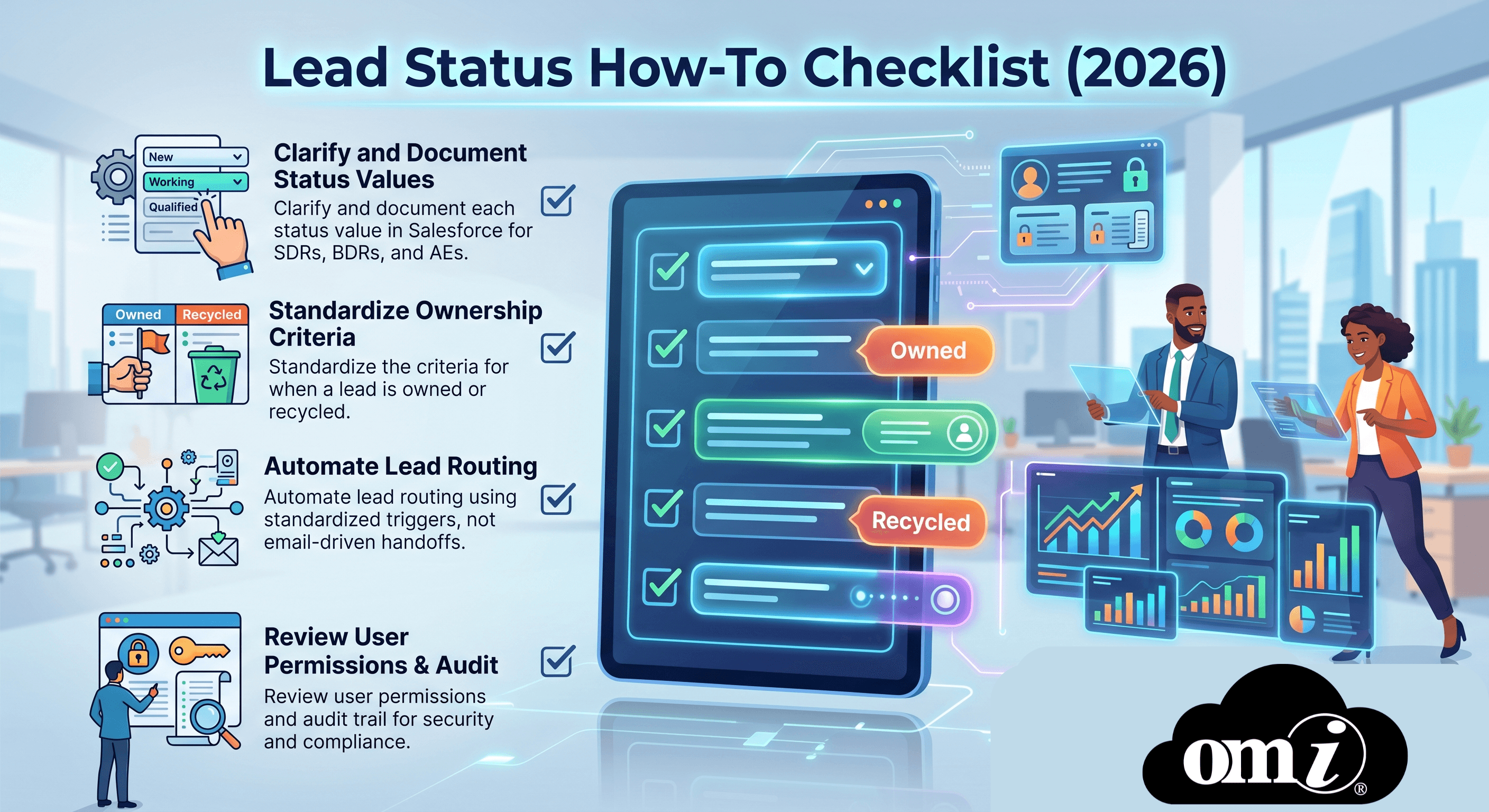
What Are Leads in Salesforce: Deep Dive into Their Role and Lifecycle
Proposed Strategies: Pivot from Manual to Autonomous
Legacy sales organizations relied on admins and sales managers to check, chase, and fix lead statuses monthly. For mid-market firms seeking digital transformation, the pivot is to standardize, automate, and audit these processes through logic-driven orchestration and managed services.
- Implement business process orchestration in Salesforce Flow, avoid patchwork automation.
- Use permissions and roles to prevent unauthorized status changes.
- Schedule quarterly OMI-led audits to flag change drift and revisit key metrics.
- Educate users on why clean lead statuses empower better forecasting and account executive productivity.
Leading-edge organizations also add reporting analytics and business intelligence frameworks atop their Salesforce lead datasets, turning data cleanliness into actionable insights for pipeline review and resource allocation.
Pro-Tip: Quarterly “funnel health” reviews, run jointly by Sales Ops and IT, catch technical debt before it grows. Leverage OMI’s managed services for hands-off compliance.
Best Practices Checklist: Human-Led, Process-Driven Cleanup
- Select a lead status owner (ideally outside direct sales) for governance continuity.
- Harmonize lead status values across integrated systems (e.g., Salesforce, Dynamics, Marketing Automation).
- Document business rules for every status, avoid “Misc” or “Other” values that invite ambiguity.
- Train new hires and review handover points quarterly.
- Apply business intelligence dashboards to monitor, not just report.
- Archive, don’t delete, historical status values for regulatory traceability.
- Perform regular permission set reviews to protect data integrity and ensure SOC2 readiness.
Pro-Tip: For highly regulated sectors, layer in compliance tracking with audit trail best practices and lock permissions to prevent unauthorized status changes. OMI provides full managed services for secure CRM optimization.
Cost Savings & ROI: Why Action in 2026 Pays Off
The ROI of investing in Salesforce Lead Status Cleanup for mid-market organizations is measurable in fewer lost opportunities, improved forecasting, alleviated IT resource burden, and greater compliance trust. Growth-stage companies working with OMI have reported transformation in real-time data visibility, reduced manual data hygiene burdens, and increased sales velocity, as illustrated in customer stories such as Premier Packaging and Downtown’s Healthcare.
- Reduced Pipeline Leakage: Cleaner data means higher conversion rates.
- Accelerated Onboarding: New hires can rely on standardized, role-based flows.
- Lower Compliance Risk: Avoid fines and data breaches with role-driven audits and documentation.
- Real-time Insights: Empower leadership with current, actionable dashboards, not stale reports.
Modern firms who treat Lead Status as a living business asset, not a static data field, position themselves to scale efficiently and adapt to regulatory and market changes faster than their competition.
Frequently Asked Questions (FAQs)
- What is the most common technical debt in Salesforce Lead Status workflows? For mid-market organizations, legacy statuses and overlapping automations are leading sources of technical debt. Regular audits by OMI help identify and remove these issues for streamlined operations.
- How often should we review lead statuses in Salesforce? Quarterly reviews are recommended for most growth-stage firms, ideally during regular business process audits or under a managed services plan. External Salesforce administration partners such as OMI can automate these checkpoints.
- What are the key differences between Salesforce, Dynamics, and HubSpot for lead management? Salesforce, with OMI-backed customization, offers the most flexible, role-specific lead status control. Dynamics 365 excels with structured B2B workflows and strong compliance support. HubSpot is fast to deploy for standard pipelines but less configurable for advanced handoffs. For a deeper dive, see Salesforce vs Dynamics vs HubSpot: Which CRM is Best for Mid-Market Businesses.
- Can OMI help with CRM migrations and data hygiene post-migration? Yes, OMI provides hands-on guidance and technical implementation for CRM migrations, ensuring lead status harmonization and complete data hygiene, including post-migration cleanup support. Learn more at by contacting us today!
- Why does clean lead status data matter for compliance (SOC2, GDPR)? Accurate, auditable lead status data ensures you maintain proper audit trails and permissions, which is critical for regulated industries. Misaligned or outdated statuses can result in compliance gaps that OMI’s managed services are designed to close.
Conclusion: Turn Technical Debt Into Opportunity with OMI
Mid-market digital transformation is not a future vision, it’s an urgent priority. Addressing Salesforce Lead Status cleanup through process-driven audits delivers measurable ROI from pipeline accuracy, compliance, faster onboarding, and freedom from legacy bottlenecks. By partnering with OMI, your growth-stage business gains not only best-in-class Salesforce integration, but a scalable framework for CRM optimization, backed by nearly 30 years of proven expertise.
Explore how your team can maximize efficiency and advance your lead lifecycle by connecting with OMI’s CRM managed services experts today.
For more insights, see our in-depth articles: Deep Dive: Salesforce Lead Lifecycle and our technical Salesforce blog for the latest on CRM optimization in 2026.