Solving CRM Technical Debt with ABM Automation
June 29
CRM Configuration
Blogs

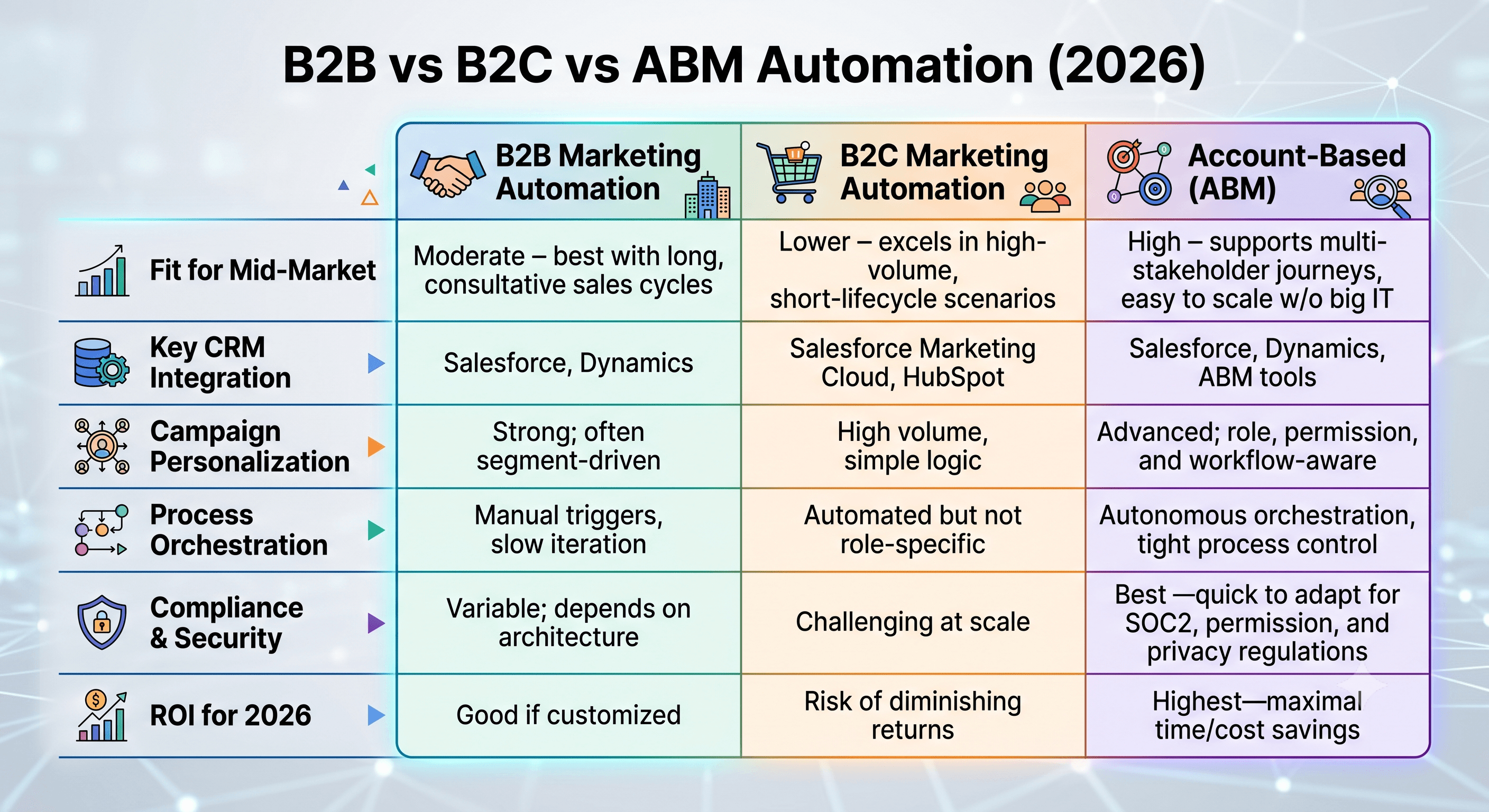
For mid-market organizations aiming to accelerate digital transformation in 2026, the decision between classic B2B/B2C marketing automation and account-based approaches is at a tipping point. As advanced CRMs like Salesforce and Microsoft Dynamics become standard, the landscape has shifted from traditional automation to integrated, autonomous, and deeply personalized orchestration. But which approach, B2B, B2C, or Account-Based Marketing Automation (ABM,) empowers mid-market teams to break growth bottlenecks while maintaining scalability and governance? In this guide, we examine the "big three" marketing automation models, framing our analysis around real 2026 challenges: technical debt, data integrity, and the rise of agentic orchestration, all from the perspective of mid-market leadership. OMI draws on nearly three decades of digital transformation expertise to deliver a definitive, actionable roadmap for CTOs, VPs of Sales Ops, and IT Directors.
In direct terms, mid-market teams in 2026 should prioritize Account-Based Marketing Automation, built on CRM platforms like Salesforce and Microsoft Dynamics, when pursuing scalable, process-driven marketing. Compared to traditional B2B or B2C models, ABM provides unified data visibility, targeted engagement, and streamlined workflows, enabling operational efficiency without requiring massive IT investments. The upshot: ABM reduces technical debt, supports data governance frameworks, and aligns tightly with sales ops and revenue teams, essential for growth-stage companies managing 50–500 employees.
Legacy B2B/B2C models can still have a place, especially for organizations with highly specific segmentation needs, but OMI’s experience shows that ABM’s process-centric orchestration delivers superior ROI, agility, and compliance for most mid-market deployments. Let’s break down each model and surface best practices for 2026 success.
Defining the Big Three: B2B, B2C, and Account-Based Marketing Automation
- B2B Marketing Automation: Focuses on logic-driven automation to nurture prospects through a complex sales journey, often relying on workflows and content tailored to business audiences. Integration with CRMs like Salesforce and Dynamics is common for campaign management and lead lifecycle trac king.
- B2C Marketing Automation: Prioritizes high-volume, rapid-response workflows targeting consumers. Includes email, SMS, and social automation with advanced personalization, but typically has shorter, less consultative sales lifecycles.
- Account-Based Marketing Automation (ABM): Aligns marketing and sales to target specific high-value accounts, orchestrating multi-touch campaigns, permissioned data access, and cross-channel engagement. ABM software leverages CRM technical debt audits, data deduplication, and decision-making frameworks central to mid-market growth and security mandates. OMI delivers tailored ABM managed services for teams requiring agile execution with enterprise-grade controls.
2026 Mid-Market Stakes: Why This Decision Matters Now
Today’s mid-market firms face increasing complexity. As marketing and sales teams strive for agility, many struggle with "invisible costs" lurking in their tech stacks, fragmented systems, manual data entry, and outdated automation logic. The most acute risks for growth-stage teams:
- CRM Technical Debt: Accumulated over years of rapid adoption, poor data governance creates permission chaos, redundant workflows, and exposes vulnerability to integration failures.
- Manual Workflows: Non-standardized processes and siloed campaign orchestration lead to missed opportunities and compliance risks.
- Fragmented Visibility: Without unified account views, marketing ROI and customer experience degrade, making it harder to justify spend or diagnose campaign performance.
Pro-Tip: Mid-market decision-makers should immediately audit their CRM and marketing workflow architecture for data cleanliness and permission set sprawl. This single exercise can uncover technical debt that stalls automation at scale.
Pro-Tip: Use a platform like Salesforce or Microsoft Dynamics, supported by OMI’s managed integration services, to anchor ABM strategies. Ensure the CRM foundation is audited for legacy technical debt before scaling automation.
Identifying the Cost of the Status Quo: Hidden Risks in Manual & Siloed Automation
For mid-market decision-makers, the status quo often means inherited technical debt: manual processes, patchwork automation, unstandardized permission sets, and data silos. The consequences are real:
- Wasted Admin Hours: Repetitive list uploads, deduplication, and troubleshooting instead of analysis and strategy.
- Missed Revenue: Slow response to buying signals, late follow-ups, or fractured customer journeys.
- Compliance Gaps: Fragmented systems raise risks around GDPR, SOC2, and other critical regulatory frameworks.
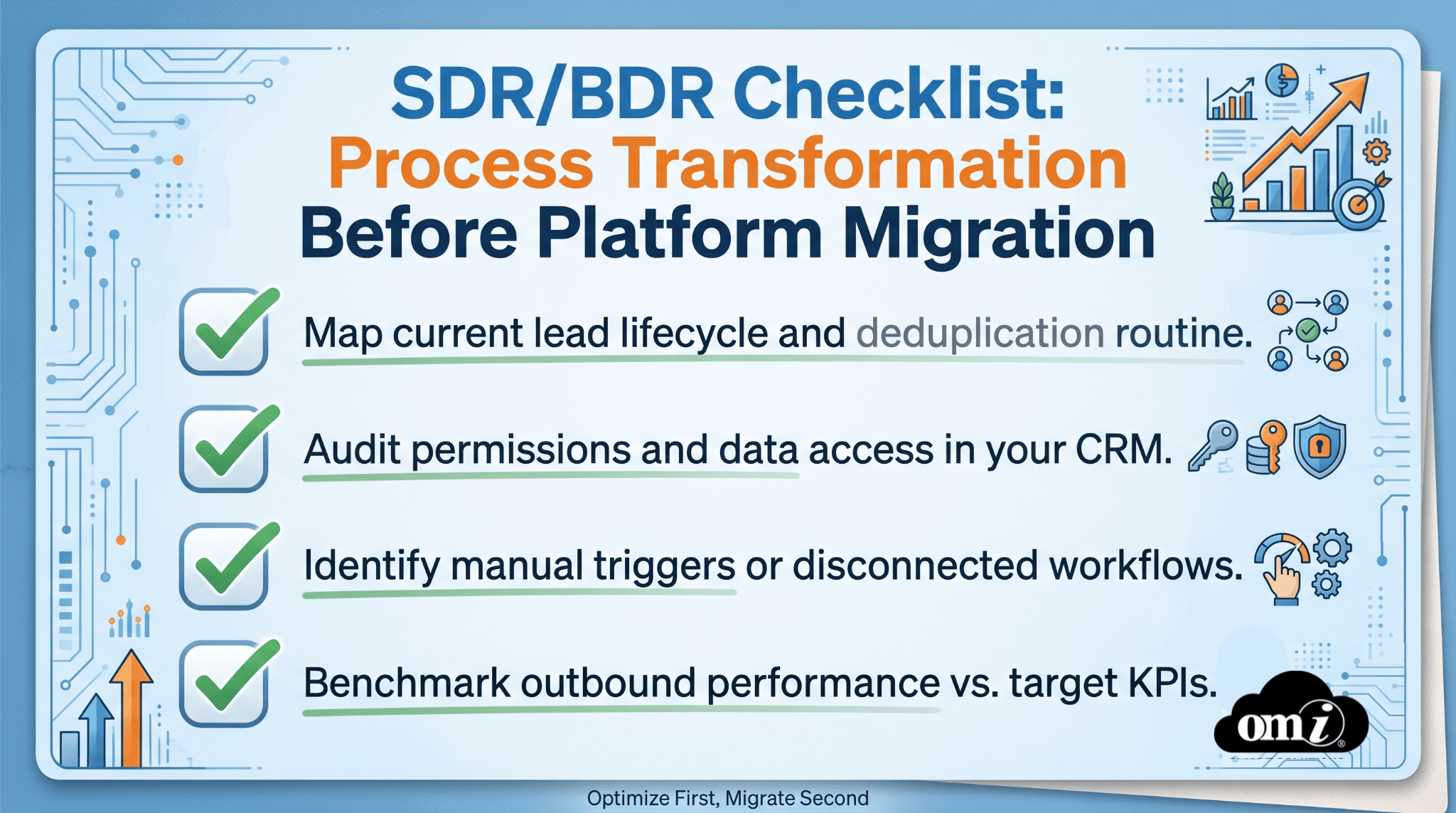
Transitioning to ABM automation is less about the platform and more about building standardized business processes. Many clients turn to OMI’s managed CRM services to conduct these foundational audits and process migrations.
The Pivot from Manual to Autonomous ABM Orchestration
1. Audit Your CRM for Technical Debt
- Conduct a full data quality scan and deduplication check.
- Identify legacy automations, unused custom fields, and permission set bloat.
- Leverage OMI's expertise for Salesforce and Dynamics audits to pinpoint hidden risk.
2. Standardize Process Flows and Permission Models
- Map out SDR vs. BDR workflow requirements, no more template re-use without context.
- Create a master-detail vs lookup relationship chart to clarify data hierarchies.
- Integrate audit trail best practices into all critical platform migrations.
For a deep dive on workflow architecture, see our Salesforce leads lifecycle blog.
3. Integrate Data Across Platforms
- Use API management and cross-platform data flow best practices to unify engagement data.
- Partner with platform experts (as OMI does) to orchestrate seamless flows with zero downtime.
Best Practices Checklist: Building a Compliant, Scalable ABM Ecosystem
- Start with Data Governance: Build a CRM data deduplication schedule and enforce strong permission set management.
- Prioritize Process Orchestration: Leverage Salesforce Flow optimization and model all critical SDR/BDR transitions. Transition from template-based nurture to logic-driven automation.
- Embed Compliance from the Start: Ensure SOC2, GDPR, and privacy rules are part of your process, not afterthoughts. This is particularly vital for regulated industries and for demonstrating security maturity in RFP cycles.
- Measure Time and Cost Savings: Set baseline SLA metrics before migration, then document time reclaimed via each ABM workflow deployed.
- Lean on Managed Services as a Force Multiplier: Outsource management of your CRM and automation platforms with expert partners like OMI to reduce technical overhead and focus your team on analysis and growth.
Pro-Tip: Standardize all reporting analytics using integrated BI tools for unified stakeholder visibility. See OMI’s business intelligence frameworks for guidance.
ROI & Cost Savings: Why Mid-Market Firms Move to ABM Automation in 2026
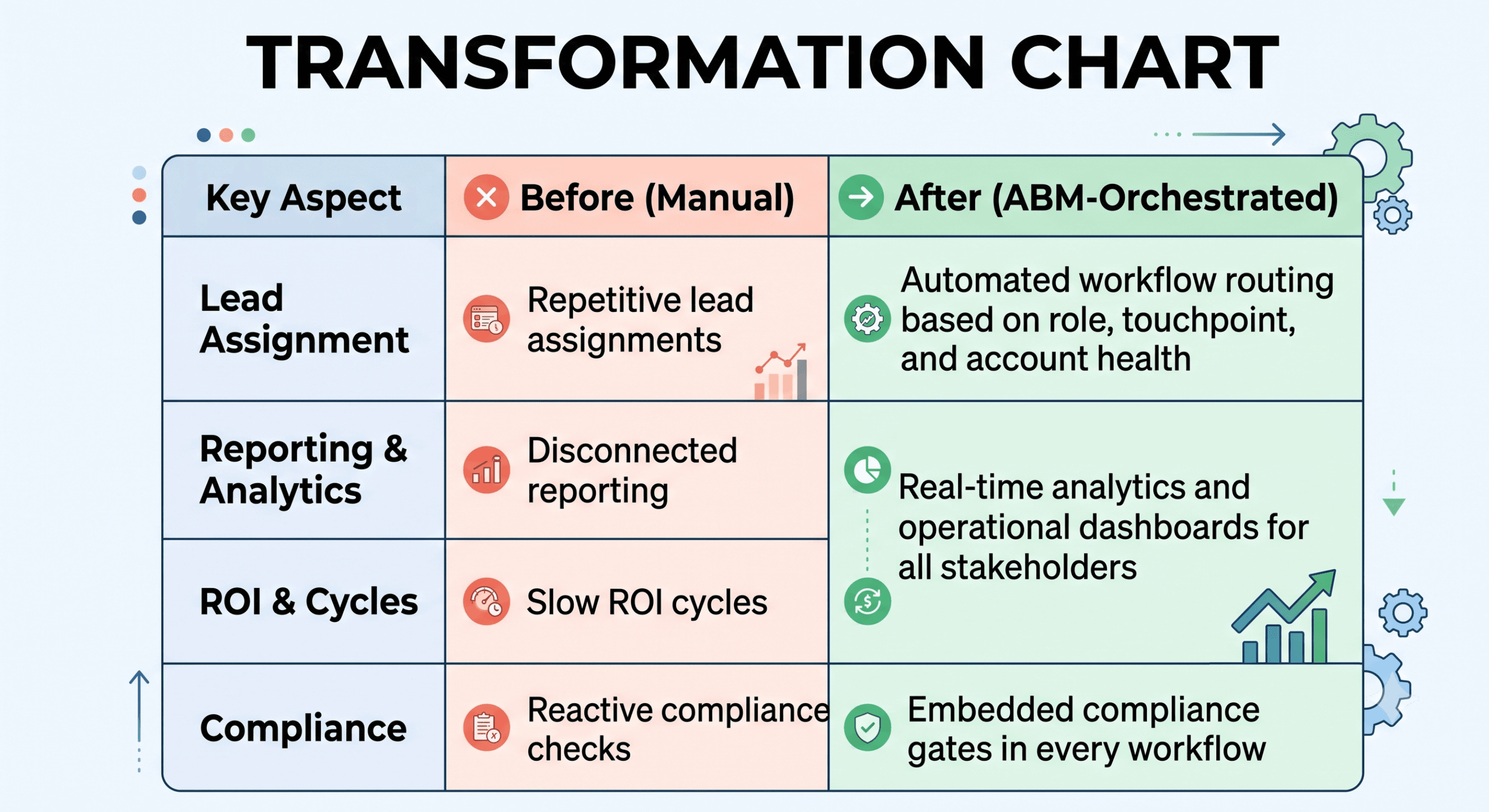
Mid-market decision-makers prioritize solutions that deliver immediate ROI, operational simplicity, and regulatory confidence. ABM automation, especially when anchored on platforms like Salesforce and Microsoft Dynamics with expert integration by OMI, enables teams to:
- Reduce Time-to-Deploy: Reusable workflows and managed service models speed up campaign launch cycles.
- Free Internal Resources: Fewer manual admin tasks mean more time for strategy, cross-team collaboration, and growth initiatives.
- Increase Compliance Posture: Embedded audit trails, permission templates, and automated compliance checks lower audit risk.
- Elevate Analytics: Unified dashboards drive real-time reporting and more effective executive decision-making.
This compounding ROI is what drove organizations to partner with OMI for CRM and ABM modernization. For more on how these projects delivered business transformation, explore our case studies.
Frequently Asked Questions (FAQs)
- What is the difference between B2B, B2C, and Account-Based Marketing Automation? B2B marketing automation builds logic-driven workflows for multi-stage business sales cycles, while B2C automation targets high-volume, fast-conversion consumer campaigns. Account-Based Marketing Automation orchestrates human-led engagement, aligning marketing and sales to specific high-value accounts. ABM, when deployed on a unified CRM like Salesforce or Dynamics, offers superior process standardization for mid-market teams. OMI’s CRM services enable seamless transitions between these models.
- Why do mid-market teams in 2026 favor ABM automation over classic models? ABM provides unified account visibility, robust permission management, and automation frameworks tailored for scalable deployment, all essential for firms with 50–500 employees who lack large internal IT support. It also answers technical debt, compliance, and operational efficiency challenges. OMI’s managed ABM migrations ensure process over platform, maximizing business impact.
- How can I audit and clean CRM data before migrating to ABM? Begin with a technical debt assessment: identify duplicates, legacy automations, and permission set sprawl. Use a structured framework, such as the one outlined in OMI’s 27-Year Blueprint and consult services for data cleansing, workflow mapping, and risk benchmarking.
- What tools integrate best with ABM for mid-market orchestration? Platforms like Salesforce and Microsoft Dynamics paired with managed integration partners like OMI. These enable logic-driven, standardized ABM operations without complex internal builds. Managed service offerings cover consulting, integration, data analysis, and compliance support.
Conclusion: The Path Forward for Mid-Market Growth
The "hidden cost" of legacy automation is often invisible, manifest as lost hours, compliance headaches, and stunted growth. Migrating to account-based marketing automation, with expert guidance from OMI, equips mid-market organizations to reclaim time, reduce risk, and deliver higher ROI. The path forward is clear: prioritize data cleanliness, process orchestration, and real-world compliance as you evolve your marketing technology and team workflows.
Ready to optimize your CRM, streamline your processes, or migrate legacy automations? Our team at OMI is here to help you unlock value and future-proof your business for 2026. Contact us today for a consultation or explore our recent technical deep dives, such as Salesforce leads lifecycle best practices and SDR vs BDR workflow management.
For more actionable insights, visit our blog archive where we regularly address platform comparison, CRM migrations, and digital transformation strategies for the mid-market leader.