The Hidden Costs of LLM Token Consumption on Azure OpenAI: What Most Enterprises Overlook (And Why Inexperienced Agent Developers Compound the Problem)
Blogs
For mid-market technology leaders in 2026, the promise of autonomous CRM workflows powered by Azure OpenAI is driving digital transformation across Salesforce, Microsoft Dynamics, and surrounding systems. Yet, many growth-stage organizations are being blindsided by unforeseen and rapidly escalating cloud costs, not because of list prices or intentional overuse, but because of subtle, architectural inefficiencies that most IT teams and inexperienced agent developers overlook. The true cost of Azure OpenAI in a mid-market context isn’t about advanced model pricing; it’s about how context bloat, unnecessary retries, and agentic workflow sprawl can quietly derail IT budgets and erode trust in digital transformation initiatives.
These hidden costs pose a clear risk to mid-market decision makers: unpredictable budgeting for AI-assisted features leads stakeholders to lose faith in scaled rollouts, stalls innovation, and often results in expensive digital transformation reboots. Having assessed and remediated these challenges for many clients, OMI has seen firsthand how lapses in CRM workflow architecture and poor LLM integration multiply token consumption in ways that most finance teams only discover months later. For those managing Salesforce integration, CRM optimization, or exploring managed services on Azure and Dynamics, mastering this cost dynamic is now a C-level imperative.
Below, we reveal what most mid-market teams miss about Azure OpenAI token economics, how agentic AI and inexperience compound costs, and actionable strategies for controlling your spend, complete with the structured guides and ROI checklists that our experts deploy every day.
Understanding the Real Drivers of Azure OpenAI Token Costs in Mid-Market Digital Transformation
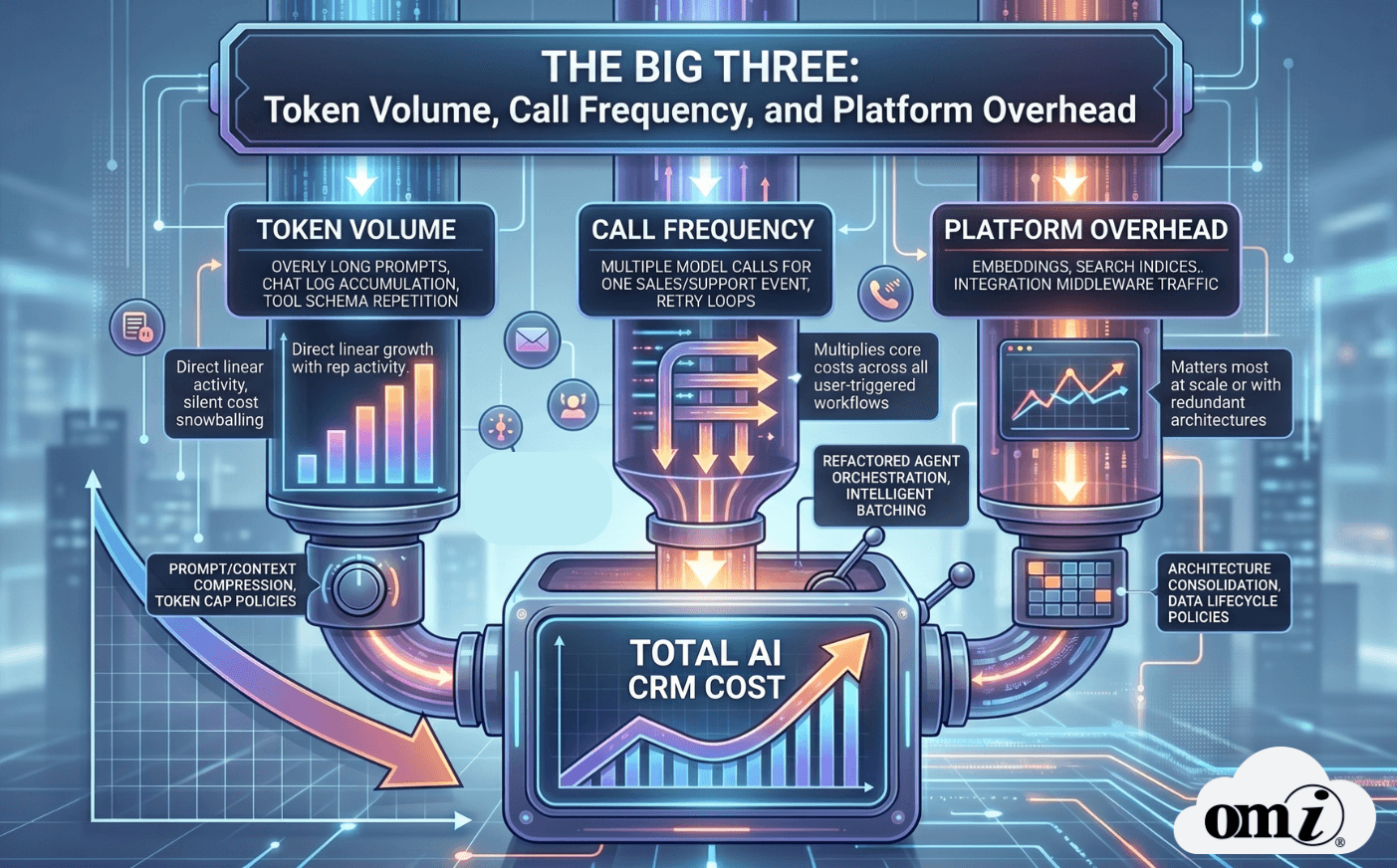
The typical starting point for a mid-market team is the Azure OpenAI pricing page: cost per 1,000 tokens, input plus output. But the real world is far more nuanced, especially for growth-stage companies scaling Salesforce or Dynamics 365 automation. Costs balloon, not merely from volume, but from embedded inefficiencies:
- Verbose system prompts, often 2-3 times longer than required, sent with every API call.
- Long-running chat histories included on every agent action or context window refresh.
- Redundant and unnecessary tool schemas or function definitions embedded in every request.
- Multiplication of AI calls per workflow step (for example: separate calls for summarization, recommendations, and drafting in the same CRM process).
- Retry storms from optimistic integration logic, compounding token use and API costs during transient failures.
Importantly, for CRM-centric environments like Salesforce and Dynamics, these inefficiencies are rarely tracked by default cloud cost tools. You may see a rising Cognitive Services bill but struggle to map that back to functional workloads, an issue detailed in Azure cost management guidance and well-observed across OMI client engagements.
Pro Tip: Analyze Input Token Patterns First
In our experience, input token bloat consistently drives 70–85% of Azure OpenAI spend in CRM workflows. Focus your audit efforts here before tweaking output or response size policies.
4 Audit Questions for Your Next IT Stakeholder Meeting: What is our average input token size per OpenAI call by CRM workflow? Which Salesforce or Dynamics events trigger the highest call volumes? Are tool schemas and prompt templates refactored to minimize repetition? Can we attribute Cognitive Services usage to individual business departments?
How Inexperienced Agent Developers Compound Token Inefficiency in CRM Workflows
As mid-market organizations pivot from manual to autonomous and agentic workflows, moving from one-off automations to AI-driven orchestration, many delegate integration scripting to generalist developers or citizen coders unfamiliar with LLM cost dynamics. This compounds token inefficiency in three primary ways:
- Overstuffed Contexts: Passing full CRM records, chat history, or knowledge base extracts for every subtask even simple ones.
- Schema Redundancy: Re-sending the entire tool/function schema with every API call, regardless of actual use per step.
- Retry Surges: Permissive retry logic triggering the same 10k-token request multiple times during brief service incidents.
For a familiar mid-market scenario: an AI agent launches on each newly created Salesforce opportunity to (1) summarize, (2) recommend next steps, and (3) draft an email. The output? Three calls, massive repeated context, and up to triple the necessary monthly token spend.
Pro Tip: Modularize Context and Collapse Multi-Step Calls
Build a single, flat context payload and share it across sequential tasks, enforcing only the fields and logic each call actually needs. This routinely reduces token volumes by 30–50% in practical CRM flows.
SDR/BDR Agentic Workflow Transformation Checklist
- Summarize CRM records to fit a 400–600 token maximum before LLM hand-off.
- Route simple classification tasks to smaller, lower-cost models before using advanced engines.
- Set hard max tokens per response, e.g., 250–300 for call notes, 200–300 for emails.
- Limit chat history to no more than 5–10 turns, using summarization.
At OMI, we implement these workflow guardrails as standard practice for Salesforce and Microsoft Dynamics managed services, ensuring Sales Ops, SDR, and BDR teams benefit from autonomous assistance without unpredictable cost exposure.
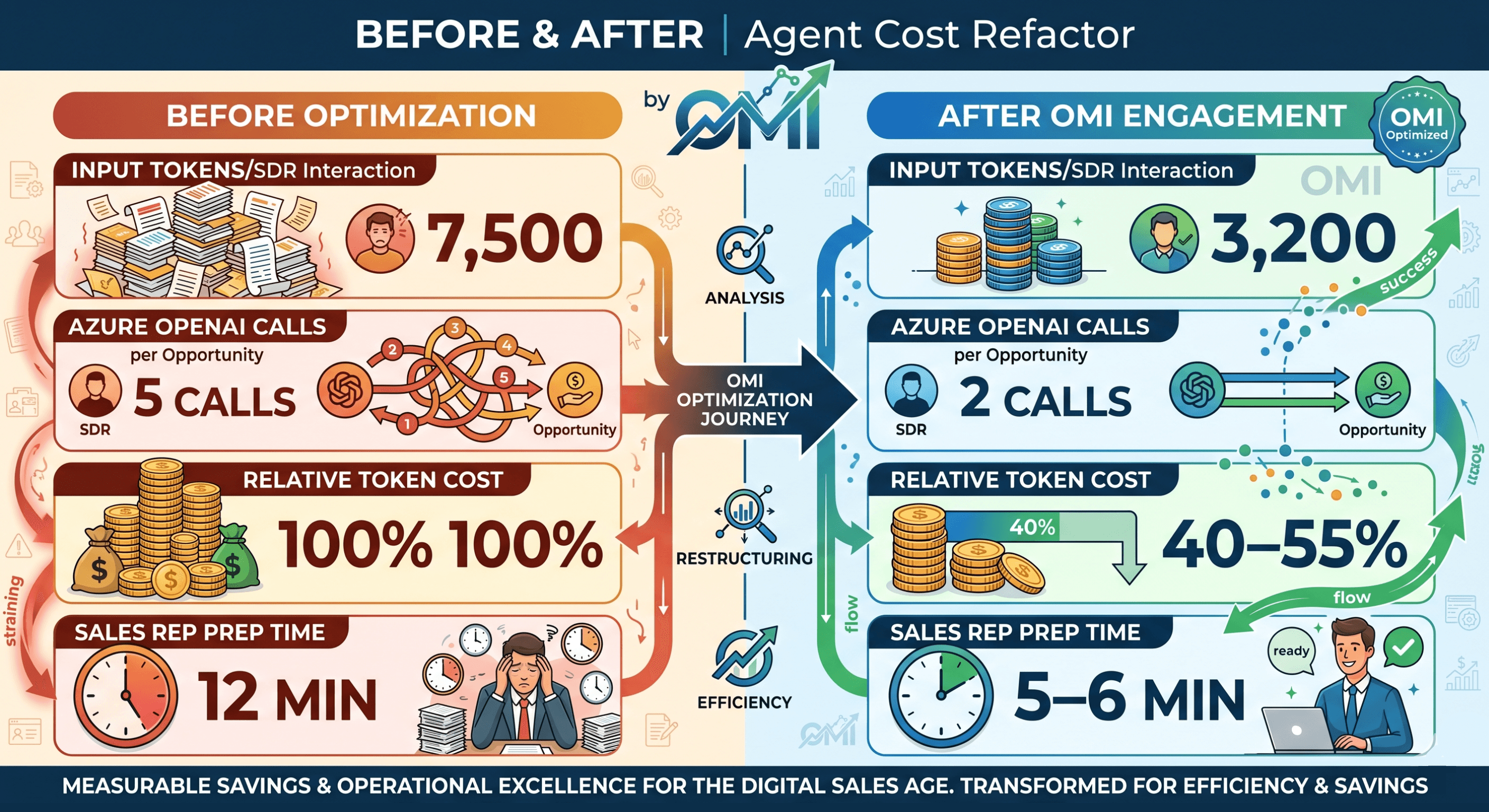
Before & After | Agent Cost Refactor by OMI
Input Tokens/SDR Interaction: Before Optimization 7,500; After OMI Engagement 3,200
Azure OpenAI Calls per Opportunity: Before Optimization 5; After OMI Engagement 2
Relative Token Cost: Before Optimization 100%; After OMI Engagement 40–55%
Sales Rep Prep Time: Before Optimization 12 min; After OMI Engagement 5–6 min
The 30-Day Token Audit Framework: Regaining Control in Growth-Stage Environments
You do not need a dedicated FinOps team to regain token efficiency. At OMI, we walk clients through this proven 30-day audit to establish transparency, reduce waste, and make future CRM optimization decisions with confidence:
Week 1: Gain Visibility
- Enable diagnostic logging for Azure OpenAI, linking each call and token use to named CRM/app workflows.
- Tag Azure resources by business function and department (e.g., app=salesforce-integration).
- Use Azure Cost Management filtering for real-time tracking.
Pro Tip: Track Unit Economics | Not Just Spend
Tie token spend to actionable units (cost per opportunity, cost per support ticket, cost per campaign). This is the metric your CFO and ops teams need for ROI decisions.
Week 2: Identify Context Bloat and Redundancy
- Sample the top 10–20% of high-volume requests by workflow.
- Segment and measure token use by system prompt, payload, and history.
- Challenge each inclusion: Is this context necessary for this decision/action?
Context Bloat Health Check
• Are full CRM records or compact payloads being sent?
• Are email threads being summarized or dumped in full?
• Is retrieval limited to 3–5 high-relevance snippets?
• Do prompts repeat standard instructions that could become references?
Week 3: Implement Token Guardrails in Your CRM Integration
- Introduce token caps at both app and API config levels, with logging for exceptions.
- Standardize prompt libraries, reuse, don’t reinvent.
- Route lightweight tasks to smaller models and reserve advanced models for synthesis/complexity only.
- Set retry/backoff policies, especially for high-token calls.
In Salesforce, these guardrails frequently sit within Apex services, platform events, or middleware orchestration, full integration patterns that our OMI engineers have standardized across 1,000+ projects. Read more on integration strategies in our comprehensive guide on Salesforce Integration.
Week 4: Forecast, Budget & Operationalize
- Model the forecasted monthly user actions by workflow and apply new, optimized token assumptions.
- Set the cost per unit (opportunity, support case, campaign email) as a recurring KPI.
- Establish monthly budgets in Azure Cost Management with threshold-based alerts and actions.
30-Day Token Audit Milestones
• 25–40% average input token reduction per critical workflow
• 30% or more call consolidation achieved
• Unit cost baselined for three core business KPIs
• Token guardrail policy documented and socialized
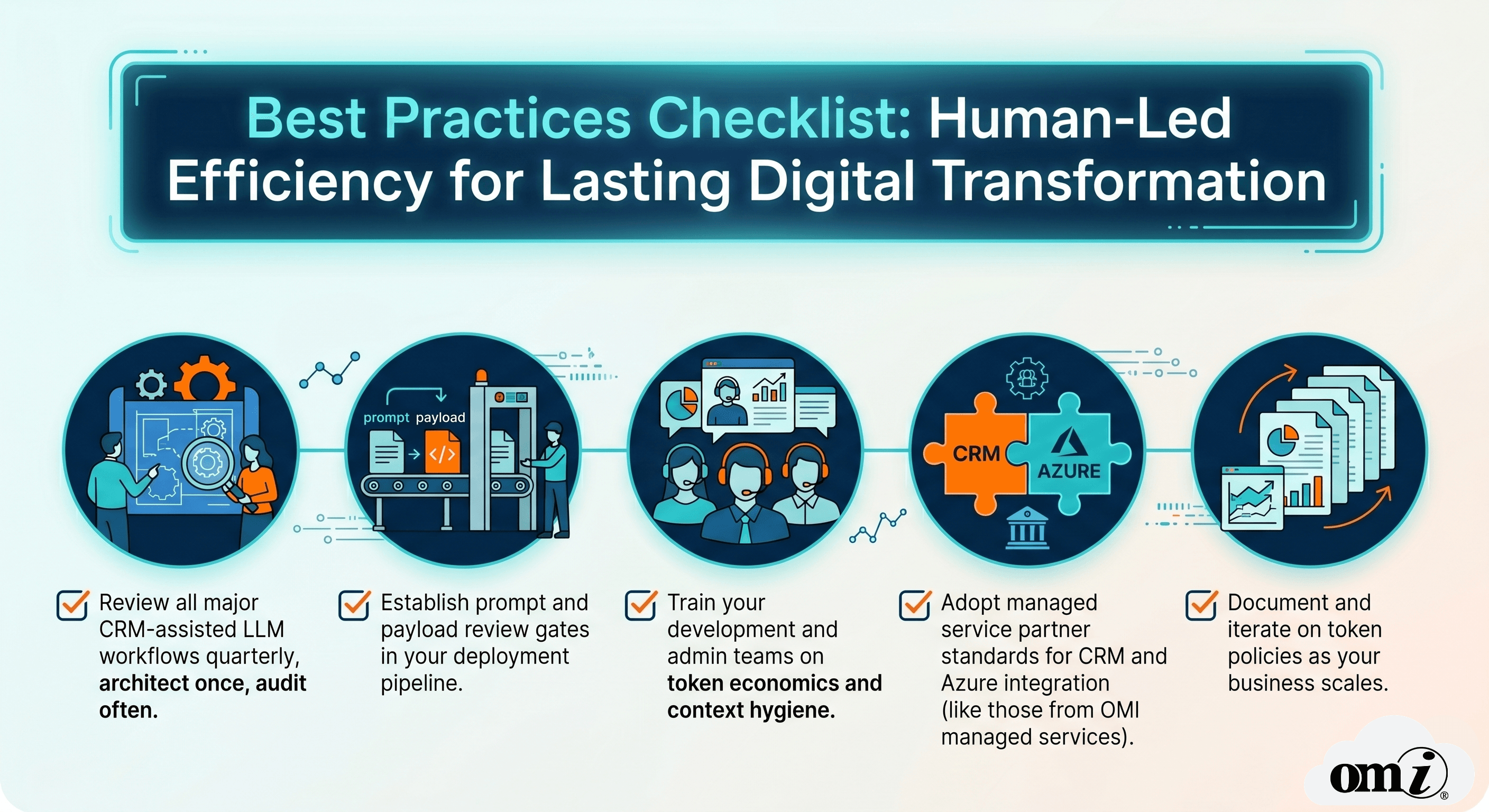
Best Practices Checklist: Human-Led Efficiency for Lasting Digital Transformation
- Review all major CRM-assisted LLM workflows quarterly, architect once, audit often.
- Establish prompt and payload review gates in your deployment pipeline.
- Train your development and admin teams on token economics and context hygiene.
- Adopt managed service partner standards for CRM and Azure integration (like those from OMI managed services).
- Document and iterate on token policies as your business scales.
The ROI of Proactive Token Management: Growth Without Surprises
For mid-market leaders, the payoff for disciplined token management is clarity and control, lower Azure bills, faster response times, and the confidence to scale agentic CRM automation. From OMI-supported integrations, many organizations have realized:
- 30–60% drops in Azure OpenAI spend for key workflows
- 20–40% faster CRM user experiences from smaller, leaner prompts
- Greater trust and forecastability for stakeholders budgeting digital initiatives
- Reduced compliance risk through better logging and data minimization
This transformation paves the way for more advanced CRM optimization: improved lead lifecycle management, modernized integration between Salesforce, Dynamics, and marketing automation, and smarter business intelligence frameworks. Those interested in deeper technical dives may also find value in OMI’s perspectives on comparing top CRMs for the mid-market and building enterprise-grade analytics pipelines.
Frequently Asked Questions: Hidden Costs of Azure OpenAI Token Usage
- How can I see the actual Azure OpenAI cost for each workflow? Navigate to Azure Portal > Cost Management + Billing > Cost Analysis and filter by Cognitive Services resources. Tagging by application (for example, salesforce-integration) allows you to break down spend by workflow. OMI frequently sets this up as part of a digital transformation engagement.
- What is the most overlooked source of token waste in CRM? Context bloat, sending complete CRM records or long histories by default. Instead, summarize or compress records before sending. OMI’s Salesforce integration experts address this as part of every new workflow build.
- How do we estimate the future cost of new OpenAI-powered features?
- Estimate monthly user triggers of the featur
- Multiply by number of OpenAI calls per us
- Multiply by assumed input/output tokens per cal
- Apply the model rate, add 10–20% for platform overhead
OMI’s implementation roadmaps always include this modeling step as a core part of strategic CRM optimization.
- Are embeddings and vector search a significant part of token costs? Some workflows incur periodic costs to generate and maintain vector embeddings (think: search, RAG-enhanced customer support). Poor housekeeping leads to runaway costs, so data lifecycle management and relevance filtering are core to OMI architectural patterns for both Salesforce and Dynamics.
- Is building our own agent framework worth the potential cost exposure? Building in-house gives flexibility but makes you solely responsible for token economics, logging, and security. OMI clients often combine custom development with managed service oversight to lock in best practices and predictable CRM operating costs.
- Does CRM data quality affect OpenAI costs? Absolutely: technical debt and messy, duplicated CRM data inflate token budgets by requiring more conditional logic and retrieval, which multiplies both friction and expense. Cleaning data and enforcing clear data governance structures, like those advised by OMI, drives both efficiency and accuracy. For more, see our article on data pipeline best practices.
Conclusion: Elevate Your CRM Transformation With OMI
In 2026, as mid-market and growth-stage companies double down on agentic CRM automation and digital transformation, the architect behind your Azure OpenAI integration is just as important as the model itself. By prioritizing process over platform, auditing token flows, and standardizing best practices, you can reclaim budget, build trust, and accelerate innovation, without scaling technical debt. If you are ready to optimize your Salesforce or Dynamics integration for cost, compliance, and business agility, contact OMI today. Let’s make your CRM investment truly future-proof.
For more practical insights, browse our blog: OMI Blog.