Scale Your CRM Without Hiring: Salesforce Managed Services Guide
Blogs
Managing a Salesforce environment is an ongoing journey rather than a one-time project. For small and midsize businesses, the most daunting challenge isn't the technology itself, but keeping up with daily administration, backlog prioritization, and frequent release testing, all without the cost and complexity of building out a full in-house team. As a certified Salesforce partner with nearly three decades of experience, we at OMI have seen firsthand how this strain can hold back digital transformation, user experience, and ultimately, business growth.
Why Ongoing Salesforce Management Is Essential and Challenging
Salesforce is a powerful platform, but it evolves at a pace that is hard to match without dedicated resources. New features, changing compliance needs, evolving business processes, and the daily requests of users can easily overwhelm a lean IT staff. Here’s where the model of managed services becomes a game changer:
- Continuous Administration keeps everything secure, quick, and clean. Tasks like proactive user management, permissioning, data quality, and configuration changes demand expert, ongoing attention.
- Backlog Triage ensures that enhancement requests, integration needs, and bug tickets don’t pile up, causing delays or impacting business outcomes.
- Release Testing & Governance safeguards every Salesforce update. Each major release, patch, or new integration must be tested in your unique environment before making its way to production.
The challenge intensifies as business complexity grows, and most organizations struggle to justify a dedicated admin or IT ops team focused purely on CRM. This is precisely the gap we fill at OMI, in a way that is flexible, predictable, and deeply aligned to your business goals.
The High Cost of the "Accidental Admin" (The Cultural and Financial Risk)
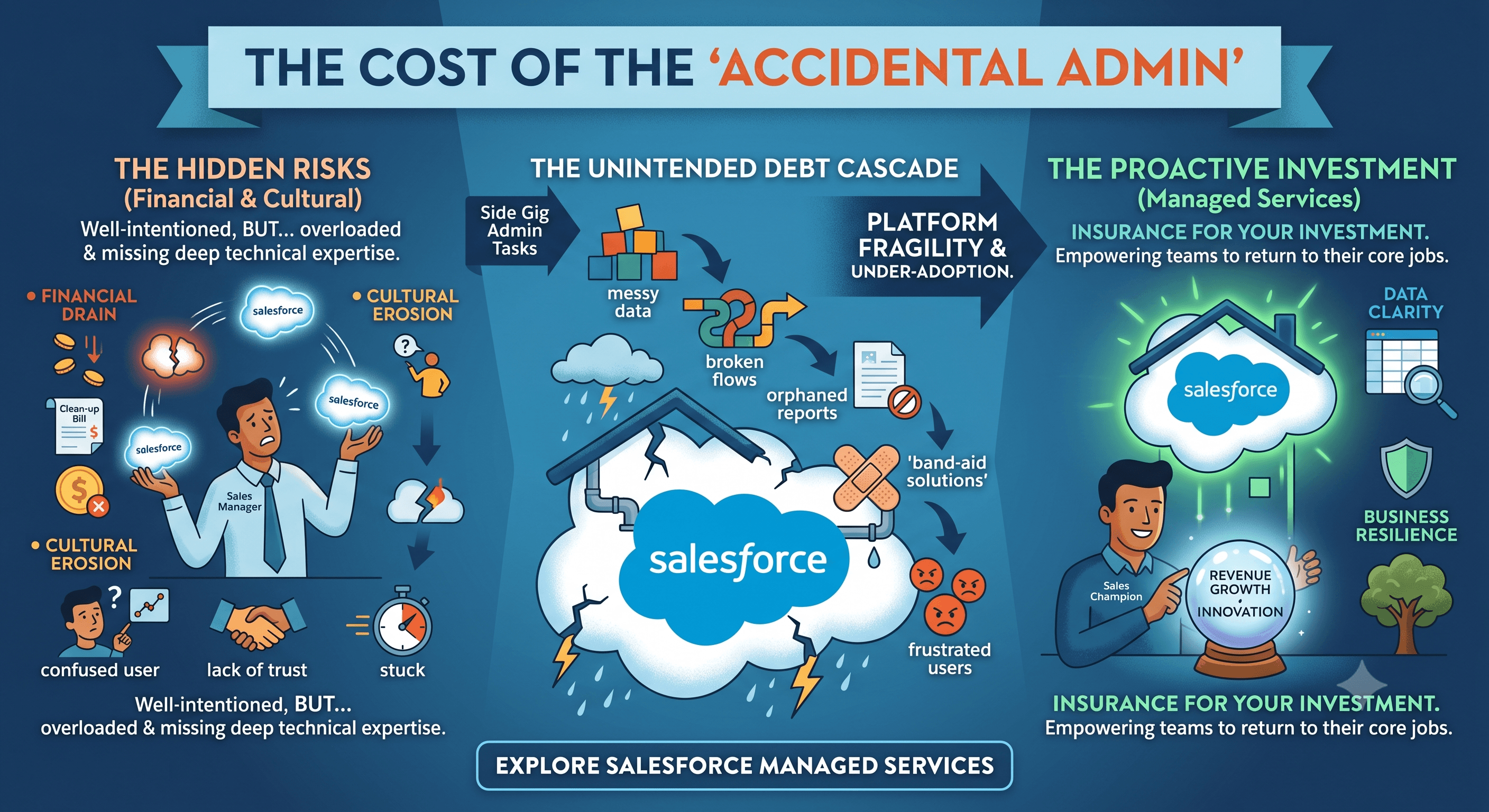
Many SMBs don’t realize they have a Salesforce management problem until their entire platform breaks or a key employee walks out the door. It’s surprisingly common for companies to hand off Salesforce admin tasks to a high-performing sales manager, operations lead, or IT generalist as a "side gig." This creates the phenomenon of the "accidental admin." While these employees are well-intentioned and eager to help, they rarely possess the deep technical or architectural knowledge required to maintain a healthy, scalable Salesforce ecosystem.
Over time, this approach can quietly build up technical debt, messy data, broken flows, orphaned reports, and band-aid solutions that frustrate users. Eventually, the system becomes cumbersome, confusing, and under-adopted. Users look for workarounds or stop trusting CRM data altogether. The true costs show up down the road: expensive clean-up projects, missed sales opportunities, compliance headaches, and culture-wide skepticism about the platform.
Introducing Salesforce managed services isn’t about replacing your talented people. It’s about insurance for your investment, giving your internal champions time to return to their real jobs, growing revenue, serving customers, or innovating, without being distracted by broken validation rules or login issues. It is a proactive investment in business resilience and data clarity, not just a reactive fix to technical emergencies.
What Are Salesforce Managed Services?
And Why SMBs Are Embracing Them
At its core, Salesforce managed services means partnering with external CRM specialists to run, optimize, and safeguard your Salesforce platform as if it were their own. But not all providers take the same approach. We believe it requires expertise, flexibility, and a consulting mindset, not just technical know-how.
- Comprehensive Admin Support: From user onboarding/offboarding to permission management, reporting, automation, and day-to-day support, experienced admins free your team to focus on high-impact work.
- Strategic Backlog Triage: Every requested enhancement, bug fix, or new workflow should be captured, assessed, and delivered based on the value to your business. No more stack of ignored tickets.
- Meticulous Release Testing: Every Salesforce update presents opportunity but also risk. We set up sandboxes, conduct regression and user acceptance testing, and deploy features only after full validation.
- Forward-Looking Roadmapping: Regular reviews with leadership help you align CRM investment with emerging business strategies and identify opportunities for automation, integration, and process improvement.
For SMBs without the budget or need for a full-time, multi-role Salesforce team, managed services delivers high-caliber expertise without the staffing headaches.
Breaking the Vicious Cycle of the Tech Backlog (Operational Velocity)
One of the biggest threats to operational agility is the quietly growing CRM backlog. As requests from frontline sales, marketing, and operations teams accumulate, progress starts to stall, not just for IT but for the entire business. A sales rep may request an update to the pipeline stages or a new dashboard to track quarterly quota. If that request sits unresolved for several months due to the admin juggling password resets or dealing with bugs, the rep loses momentum and, soon enough, stops asking.
Even worse, employees start building their own workarounds, tracking customer data in Excel spreadsheets, emailing sensitive information, or relying on legacy systems outside Salesforce. These shadow processes create new risks, siloed data, duplication, and even compliance exposure.
Managed services change the game by serving as a pressure release valve for these bottlenecks. OMI’s approach creates a predictable, continuous cadence for enhancements. Small changes get prioritized and delivered in real time, so users see their feedback implemented immediately. This builds strong trust, accelerates user adoption, and ensures the CRM continually adapts to evolving business strategies instead of becoming a digital graveyard.
If you’re interested in further strategies for overcoming operational hurdles in managed CRM, have a look at our detailed perspective on comparing managed services vs. in-house IT.
The Danger of the "Silent Fail" During Salesforce Releases (Risk Mitigation)
Salesforce pushes three major platform releases every year, offering fantastic new features and updates. However, buried inside those changes are potential hazards for businesses with custom code, complex automations, or interconnected third-party tools. Sometimes these updates can quietly break a lead routing automation, a well-used report, or disable an important integration, a phenomenon known as the "silent fail." No obvious errors flash up, but weeks later, someone notices critical leads are missing or automations have stopped running.
This "silent fail" is a real business risk. The interruption isn’t noticed until the pipeline dries up or customer experience starts to suffer. With managed services, organizations move from crossing their fingers and hoping nothing breaks to having a proactive partner. We start by carefully reviewing Salesforce release notes, mapping potential impacts against your customizations. Our team then performs regression testing in a sandbox environment weeks before the live rollout. Any fixes or adjustments needed are prepared in advance, ensuring the production instance remains stable and users can enjoy new features without downtime or disruption.
If you want more insights into how release management and automation can drive Salesforce resilience, explore our guide on Salesforce deployments and testing best practices.
How OMI Tackles Salesforce Administration, Backlog, and Release Testing
OMI’s approach goes beyond a typical admin-for-hire model. With our roots deeply planted in Salesforce and Microsoft Dynamics ecosystems, we are able to flexibly scale resources, adapt to business process changes, and serve as a true partner, not just a vendor. Here’s how we do it:
- Dedicated Certified Team: Our support is not a faceless helpdesk. You connect with professionals that get to know your instance, your users, and your growth goals, bringing 20+ years of experience to your environment.
- Transparent Service Model: Clients choose from monthly support packages (ideal for variable needs), or fixed retainer blocks for predictable budget planning. No long-term contracts required.
- Proactive Health Checks: We routinely audit your CRM for data integrity, process efficiency, and platform performance. Continuous monitoring helps spot issues before they impact users.
- Rapid Backlog Resolution: Every request is tracked, triaged, and addressed based on business priority. Our clients no longer worry about a mountain of unresolved tickets or disparate wishlists.
- Seamless Release Management: For each major Salesforce update, we establish a test plan, assess impacts, conduct UAT with your team, and coordinate smooth rollouts, protecting operational continuity.
Our managed services evolve as your business changes, we are not a set-it-and-forget-it solution but an extension of your digital execution strategy. Learn more about our philosophy in our deep dive contrasting in-house and managed models.
A Step-by-Step Example: Transitioning Salesforce Management to OMI
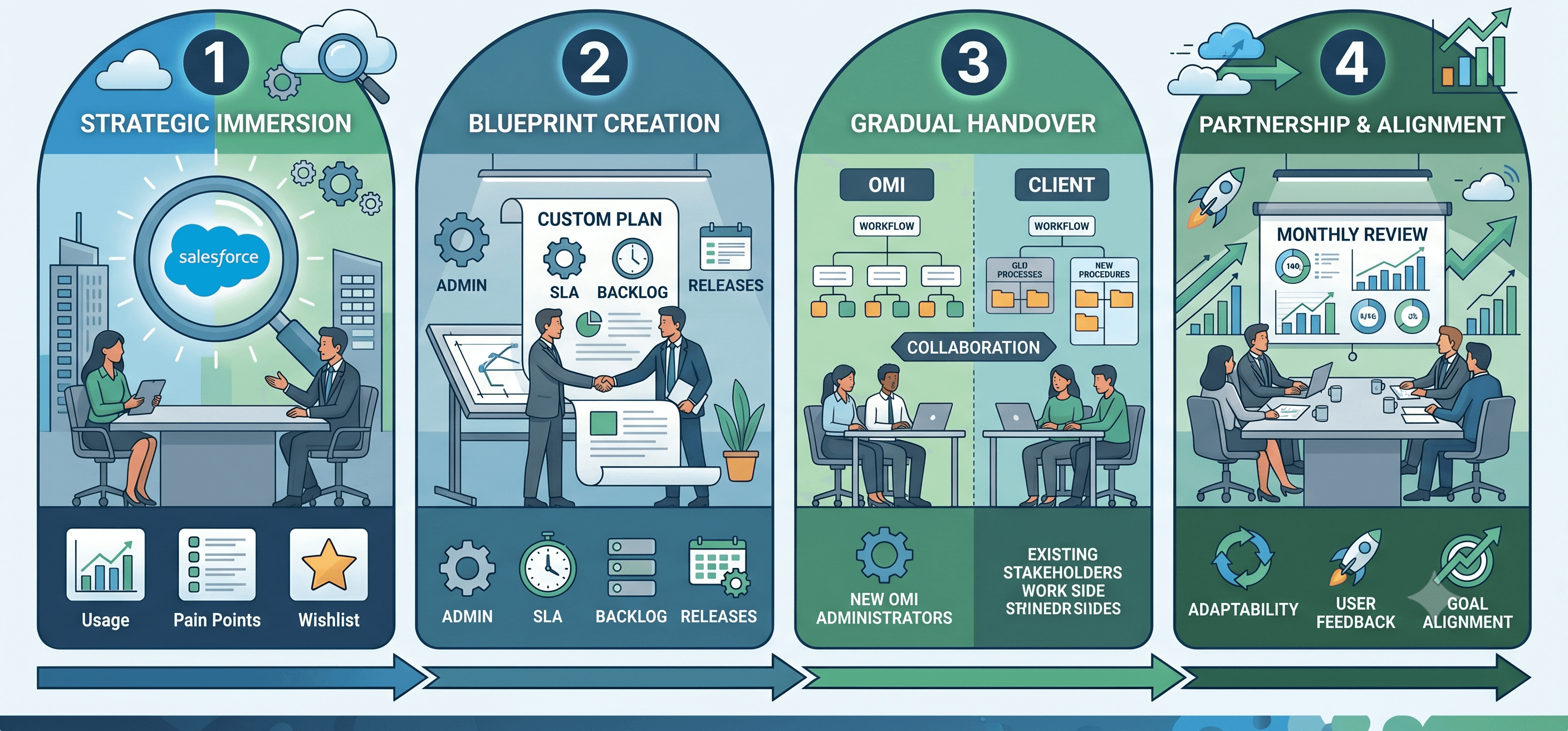
- Business Immersion: We start with a discovery session to understand your Salesforce usage, current pain points, and wish-list items. No two environments are the same.
- Custom Service Blueprint: Together, we craft a tailored plan covering admin needs, response SLAs, backlog handling, and release timing cadence.
- Gradual Transition: We phase in OMI’s team, establishing clear lines of responsibility and offering side-by-side support with your current stakeholders for seamless handover.
- Continuous Partnership: Our monthly reviews ensure we adapt to any shift in business priority, user feedback, or technology stack changes, always keeping your Salesforce platform in step with company goals.
What Sets OMI’s Salesforce Managed Services Apart?
- Decades in CRM: With thousands of projects across industries, we bring a business-first approach to Salesforce, never just ticking boxes.
- Cloud Integration Expertise: We specialize in connecting Salesforce to Microsoft Dynamics, business intelligence, and cloud APIs to ensure your CRM sits at the heart of a unified ecosystem.
- Frictionless Communication: No generic ticket portals, our clients enjoy direct access to their admin team, prioritized status reports, and ongoing strategy check-ins.
- Data-Driven: We harness analytics to uncover process bottlenecks, user adoption gaps, and missed automation opportunities with every engagement. For inspiration, explore our insights on building analytics pipelines in Salesforce.
- Proven Real-World Impact: Our approach has delivered business results for non-profits, technology providers, and manufacturers by improving data visibility, accelerating reporting, and empowering business-driven customization.
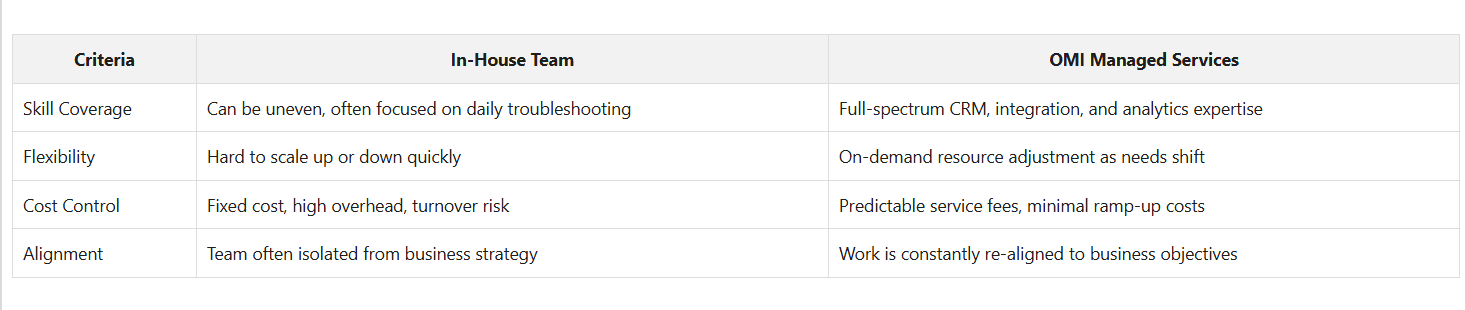
In-House vs. Managed Service: Key Differences at a Glance
Best Practices for a Smooth Managed Services Transition
- Transparent KPIs: Set clear expectations for ticket turnaround, backlog burn-down, and new feature adoption. Dashboards and scheduled reviews offer accountability.
- Frequent Communication: Bi-weekly or monthly check-ins between your main stakeholders and OMI ensure quick pivots when priorities or user needs change.
- Process Documentation: Well-documented workflows make both transition and future optimization easier, avoiding knowledge silos and lost context.
- User Enablement: Don’t just solve tickets, invest in user training and feedback loops to drive better adoption and culture of continuous improvement. See our blog on AI-powered user adoption training for actionable strategies.
Moving Forward: Is OMI Managed Services Right for You?
If your business is weighed down by Salesforce admin to-dos, a ticket backlog, or anxiety every time release season rolls around, it is time to rethink your support model. Managed services can free up your business leaders, deliver faster innovation, and help you get more value from your existing CRM investments.
A true partner does more than handle tickets, they step in as a collaborator, process optimizer, and steward of your future growth.
Frequently Asked Questions (FAQ)
- What specific Salesforce challenges does OMI solve for SMBs? We take the burden of daily admin, user support, enhancement requests, and release testing off your internal team. Our expertise means smoother upgrades, reduced downtime, and scalable resource bandwidth for ongoing innovation.
- Can OMI adjust services as our needs change? Yes, our managed services are designed to flex, whether your team is in hypergrowth or consolidating. Service packs can be scaled up or down with minimal notice, ideal for fast-moving SMBs.
- Will I still be able to make custom changes to my Salesforce setup? Absolutely. We work as an advisor and hands-on administrator. All changes are made in close consultation with your stakeholders, with detailed reviews before going live.
- How do you ensure data privacy and compliance? Our admins are trained in both Salesforce technical best practices and your industry’s compliance requirements, ensuring data integrity and secure permissions across every engagement.
- What does onboarding look like? We begin with a discovery/immersion phase, then set up clear admin protocols, define SLAs, and offer shadow support during the transition before handling tasks independently.
Expand Your CRM Knowledge
- Explore deeper strategies for managed Salesforce operations in managed CRM support for modern enterprises.
- Uncover the critical role of release testing and automation in our Salesforce deployments blog.
Effective Salesforce management doesn't have to drain your team's bandwidth or your budget. By working with a trusted partner like OMI, you can stay a step ahead of operational headaches, drive adoption, and turn your CRM into a true competitive advantage.
Interested in what seamless Salesforce managed services could mean for your organization? Connect with us for a tailored strategy session, no obligation. Let’s accelerate your CRM maturity, together.