How Unified Data Cloud in CRM Platforms Is Reshaping Sales, Service, and Marketing in 2026
April 13
CRM Configuration
Blogs

For many SMBs, the 'Customer 360' is a myth. While leadership expects real-time insights, the reality is a fragmented mess of disconnected spreadsheets and siloed CRM records. As sales, service, and marketing teams struggle to innovate, a major obstacle persists: data lives in silos. Customer information, campaign analytics, and sales activities are often scattered across multiple systems, making it tough for Salesforce administrators, CRM consultants, and IT leaders to get a unified view or actionable insights. With customer expectations rising and digital transformation accelerating, disconnected data is no longer a minor inconvenience. It’s a core barrier to delivering proactive service, targeted marketing, and high-performance sales.
The answer? Unified Data Cloud within CRM platforms. At OMI, after two decades of deep Salesforce and Dynamics experience, we’ve seen firsthand how unifying data is a game-changer for organizations that want to maximize the value of their CRM investments. By bringing together all enterprise customer data, across CRM, marketing automation, support tickets, and more, into a single, actionable source of truth, businesses have started transforming not just processes but entire outcomes. Let’s break down why Unified Data Cloud is reshaping sales, service, and marketing in 2026, and how to strategically approach its implementation for real business results.
Why Data Silos Are Stalling Growth
- Fragmented Insights: When sales, service, and marketing data are spread across tools, teams waste time reconciling and questioning the accuracy of reports.
- Slow Response Times: Support teams struggle to provide context-rich service without access to recent customer interactions or transaction data.
- Missed Revenue Opportunities: Without unified views, sales teams miss critical triggers and upsell moments, leading to lower conversion and retention rates.
The Unified Data Cloud Paradigm: What’s Different in 2026?
The shift toward Unified Data Cloud, especially within modern CRM platforms like Salesforce, means businesses no longer need to settle for partial truths. Unified Data Cloud orchestrates connections between every data source your organization relies on, cleanses and harmonizes information, and offers trusted, real-time insights within the CRM interface your teams already use daily. This isn’t just better reporting; it’s about operational agility, data-driven strategy, and personalized customer engagement at scale.
How Unified Data Cloud Transforms Sales
- Account 360° View: Sales reps can interact more intelligently when account history, deal status, support cases, and prior interactions all appear in one pane.
- Predictive Selling: Integrating AI and business intelligence helps flag likely buyers, churn risks, and cross-sell opportunities by analyzing unified behavioral, purchase, and service data.
Key Benefits for Service Teams
- Faster, Personalized Support: Service agents can view complete case history, product usage, and relevant sales data, reducing case resolution time and increasing customer satisfaction.
- Proactive Outreach: Now, service teams can set up automated workflows to engage customers before issues escalate, using data-driven triggers from across the business.
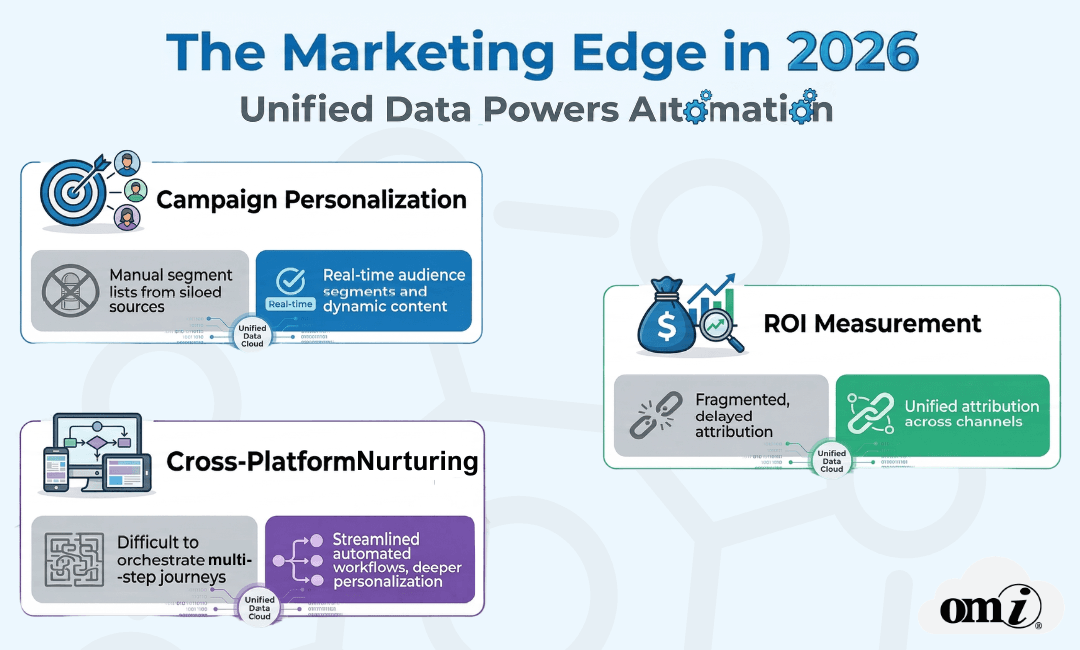
The Marketing Edge in 2026: Unified Data Powers Automation
The primary differentiator for high-growth marketing is moving from static batches to "Event-Driven" journeys. Unified Data Cloud allows marketers to move beyond fragmented and delayed attribution to a real-time strategy:
- Dynamic Personalization: Shift from manual segment lists to real-time audiences that update the moment a customer interacts with your brand.
- Behavioral Triggers: Instead of generic blasts, trigger a "re-engagement" email the moment a service ticket is closed with a positive sentiment score.
- Unified Attribution: Finally measure ROI accurately by seeing every touchpoint, from the first marketing click to the final sales contract, in one pane.
5 Steps to a Successful Salesforce Unified Data Cloud Strategy
- Start with Clear Objectives: Identify real business pain points, whether it’s slow reporting, low campaign ROI, or customer churn.
- Audit Data Sources: Map where data lives across Salesforce, marketing platforms, service apps, and third-party solutions.
- Choose Strategic Integrations: Use proven connectors for platforms like Salesforce or Dynamics to accelerate implementation without custom code where possible.
- Data Quality Matters: Prioritize cleansing and deduplication early to ensure unified data is accurate and actionable.
- Align Teams: Facilitate workshops and documentation so sales, service, and marketing teams are ready to leverage unified insights.
Overcoming Challenges with Managed Services
For small and mid-sized organizations, lack of in-house resources or specialized integration talent often stall Unified Data Cloud initiatives. This is where OMI’s managed services model delivers the most value. We operate as an extension of your team, from initial platform audit and roadmap design, through integration and continuous monitoring. Our customers routinely tell us that having dedicated experts results in faster go-live, better data visibility, and higher adoption rates, enabling digital transformation with less disruption.
Examples of Unified Data Cloud Success
- Faster Decision Making: Organizations that unify data see reports update in real time, enabling leadership to pivot quickly during market changes.
- Personalized Experiences: B2B service providers leverage unified insights to customize offers and expand existing accounts with targeted communications.
- Efficient Marketing: Marketing teams can instantly assess the impact of campaigns across all channels, and optimize on the fly.
OMI Expert Note: A common mistake we see is trying to integrate every data source at once. We recommend a 'Vocal Data' approach: start by unifying your Sales and Support data first. This provides an immediate lift in customer satisfaction and internal adoption before you tackle the complexities of ERP or third-party legacy integrations!
Conclusion: Unified Data Cloud as a Growth Catalyst
Pushing toward a Unified Data Cloud isn’t just about catching up with digital trends. It’s about delivering the seamless, personalized, and proactive experiences that modern customers now expect. For Salesforce administrators, CRM consultants, and IT decision makers in the small to mid-market, there’s never been a better time to break down data silos and unlock the full value of every customer interaction. If you’re ready to rethink how data is managed in your CRM, OMI’s experts are here to guide you from strategy through execution.
Frequently Asked Questions (FAQs)
- Why is Unified Data Cloud so critical for CRM optimization? It centralizes all your customer, sales, and support data, giving teams the full story at their fingertips and enabling data-driven decisions, predictive AI insights, and improved collaboration across departments.
- Is Unified Data Cloud only for large enterprises or can a small business afford a Unified Data Cloud? Unified Data Cloud is absolutely not only for large enterprises. SMBs benefit even more, by investing in managed services, you gain access to expertise and best-practice integrations, yielding rapid ROI without building huge internal IT teams.
- How does OMI help with Salesforce integration for Unified Data Cloud? Our certified Salesforce experts handle everything from data source mapping, connector configuration, and transformation logic to ongoing monitoring and optimization, so you don’t have to.
- Can Unified Data Cloud improve marketing automation? Yes. By consolidating campaign data, behavior analytics, and customer feedback in one place, automated journeys become more relevant, more timely, and much easier to measure for impact.
- What does a typical Unified Data Cloud project look like with OMI? We begin with business workshops and discovery, followed by design, build-out, testing, and continuous support, tailored for your industry and goals.
Interested in accelerating your digital transformation with Unified Data Cloud? Discover more about our Salesforce and CRM managed services solutions at OMI.