API Integration Services for Salesforce and Dynamics 365: How to Choose the Right Approach (MuleSoft, Boomi, Custom, or iPaaS)
April 20
CRM Configuration
Blogs
For mid-market organizations targeting scalable growth in 2026, forging the right API integration approach for Salesforce and Dynamics 365 is now a business-critical issue. As digital transformation accelerates and the marketplace shifts from simple automation to logic-driven, human-inspired business orchestration, CTOs and IT leaders face a new challenge: eliminating data silos, optimizing workflows for SDR/BDR teams, and reclaiming time previously spent on technical debt and manual workarounds. Streamlined, reliable CRM integration is the operational backbone for growth-stage companies seeking both agility and compliance amid tightening security, privacy, and efficiency demands.
Selecting between integration strategies like MuleSoft, Boomi, custom APIs, or a modern iPaaS solution must directly align with your technical architecture, team skill sets, and the immediate outcomes required, from data governance to lead lifecycle visibility. Making the wrong choice often leads to costly rework, persistent technical debt, and operational drag, keeping your team in firefighting mode instead of focusing on revenue-driving initiatives. OMI stands out as the proven partner trusted by mid-market leaders to deliver Salesforce and Dynamics 365 integrations that are scalable, SOC2-compliant, and strategically aligned with evolving business needs.
Defining API Integration for Mid-Market CRM Optimization
API integration refers to connecting business systems, such as Salesforce and Microsoft Dynamics 365, so that they can exchange data, automate logic, and orchestrate workflows across departments. For mid-market businesses, the correct integration unlocks:
- Unified customer, sales, and operational data
- Process standardization for SDR/BDR and Sales Ops teams
- Real-time cross-platform reporting analytics
- Reduced errors and compliance risks across revenue-critical systems
- Scalable, managed frameworks aligned to digital transformation and growth
Why Mid-Market Firms Need a Strategic Integration Roadmap (2026 Outlook)
Most growth-stage companies now own a variety of best-of-breed systems, leading to fragmented data flows. OMI’s experience shows that integrating Salesforce and Dynamics 365 is foundational for achieving:
- Cycle time reduction for lead-to-cash workflows
- Genuine CRM optimization through centralized data governance
- Smarter, process-led automation rather than patchwork scripting
- SOC2 compliance and robust permission set management
2026 Challenge: The Hidden Cost of the Status Quo
Core Problem: Relying on manual exports, siloed logins, and disconnected processes increases human error, technical debt, and cost. This impacts not only compliance but also the effectiveness of SDR/BDR and Sales Ops teams. In countless OMI client engagements, the most overlooked costs are:
- Data inconsistency halting reporting analytics and dashboarding efforts
- Shadow IT and user workarounds undermining permission set management
- Missed revenue due to delayed or duplicated lead handling
- Overhead on IT teams, burning cycles on maintenance instead of innovation
Pro-Tip (Data Cleanliness Checklist):
Run a 30-day audit of your CRM data for deduplication, audit trail gaps, and lead lifecycle breakdowns before choosing an integration method. Need a technical deep dive? See our Data Pipeline Best Practices post for an actionable framework.
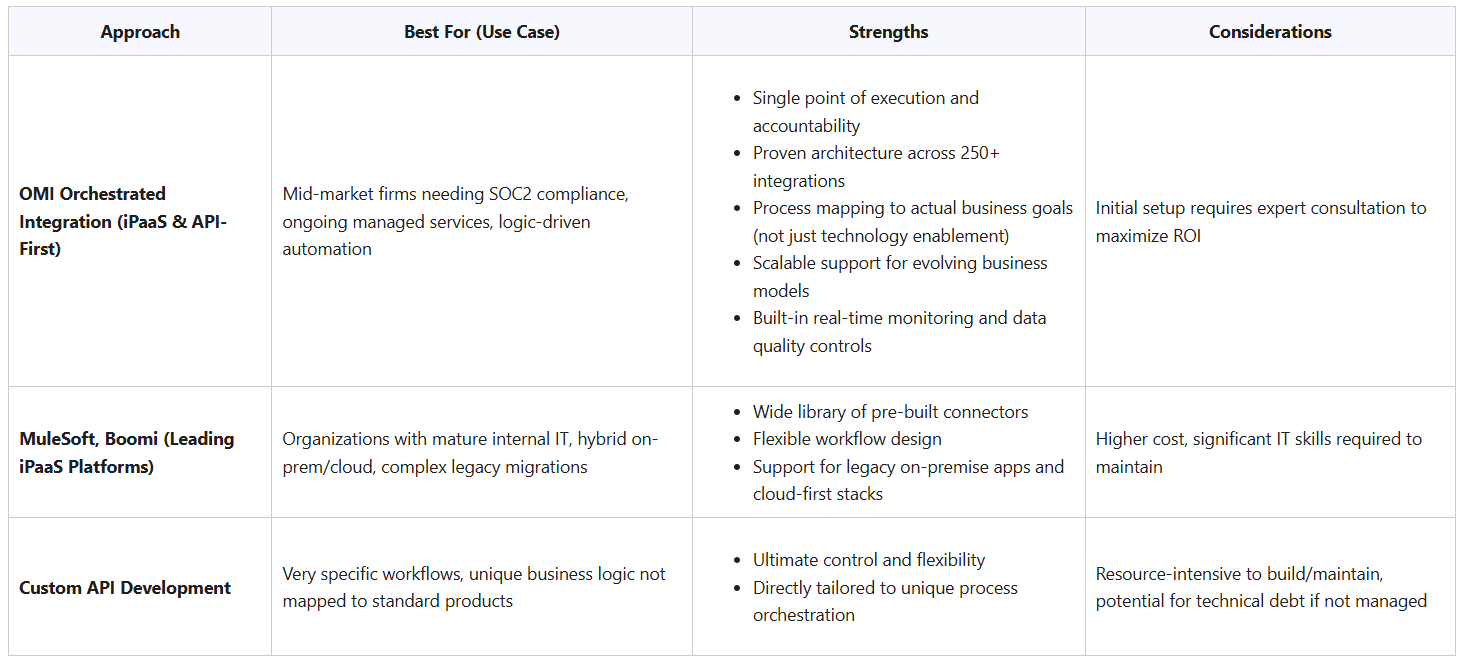
The Big Three Integration Approaches for Salesforce & Dynamics 365
Each integration approach comes with its own strengths, considerations, and architecture fit. Below is a role-based comparison to inform your 2026 CRM selection guide.
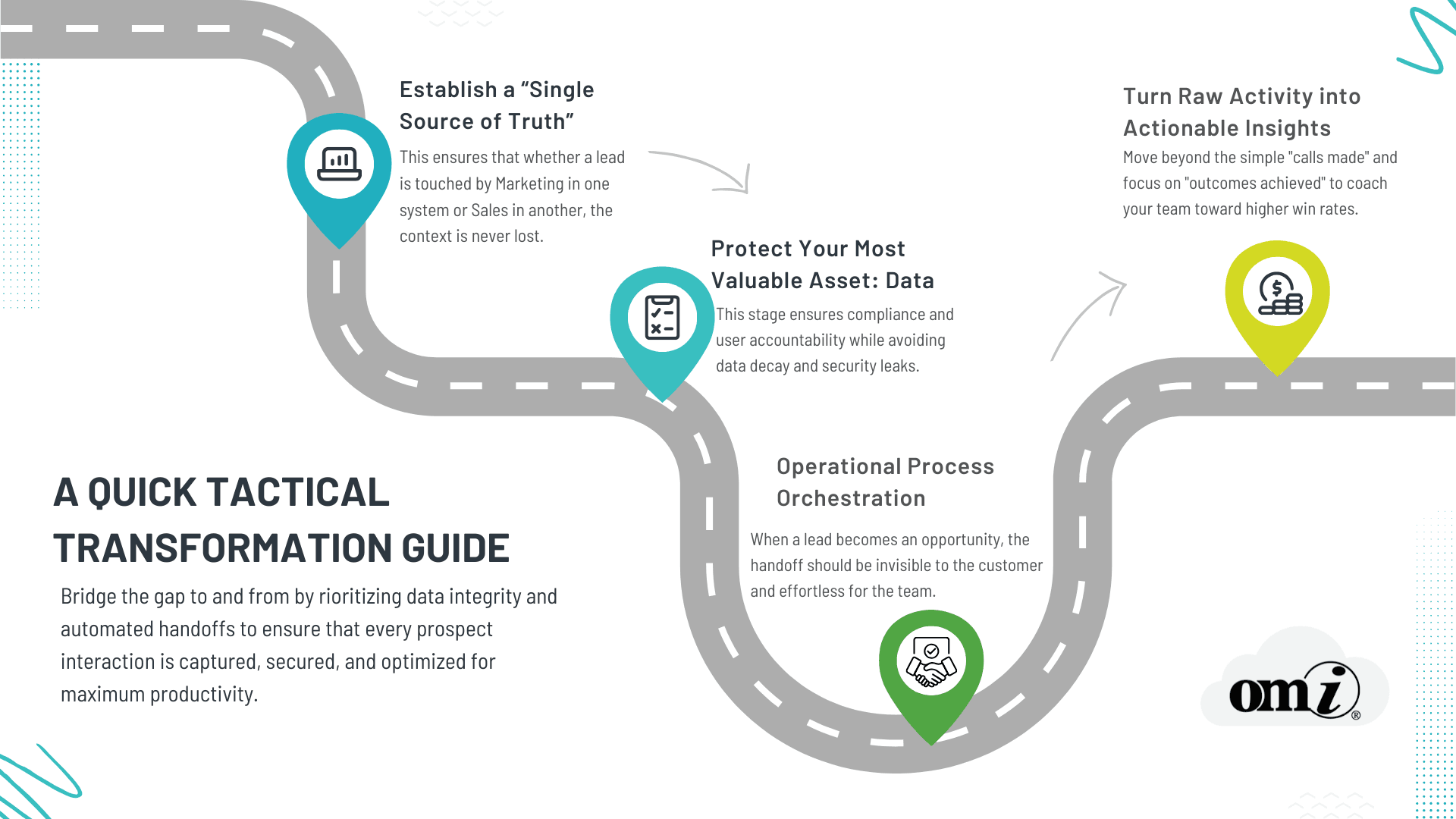
The "SDR/BDR" Checklist | A Tactical Transformation Guide
- Map lead lifecycle touchpoints for cross-platform data flow
- Audit permission sets and data governance frameworks in both systems
- Standardize process orchestration for handoff between Dynamics and Salesforce
- Build reporting analytics for Account Executive productivity
Proposed Strategies: From Manual Friction to Autonomous Integration
Mid-market growth now depends on moving beyond basic automation to orchestrated, logic-driven workflows that empower human sales and customer teams. OMI’s approach puts process over platform: analyze not just what systems can do, but how your people will use them to reach business goals.
OMI’s Unified Integration Framework
- Business Process Blueprinting: Begin with an operating model review to align integration with key growth levers (e.g., SDR/BDR efficiency, lead lifecycle automation, and compliance).
- Technical Debt Audit: Identify all current shadow integrations, manual exports, and spreadsheet dependencies across Salesforce and Dynamics 365.
- Security & Compliance Controls: Set up SOC2 compliant permission structures and ensure GDPR or industry-specific privacy controls across systems.
- Managed Services Hand-Off: Integrate under OMI’s managed support structure to minimize internal resource strain while ensuring adaptive upgrades as needs change.
Pro-Tip (Legacy Migration):
When bridging legacy ERPs or edge platforms, use a test sandbox and phased rollout for each data pipeline. Need a CRM migration reference? Our CRM transition guide offers stepwise methods for minimal downtime.
Real-World Impact: OMI Client Success Examples
OMI enabled real-time visualization and reporting via Salesforce and Flowgear integration, eliminating recurring manual processes and delivering self-service dashboarding to internal business units. The result: instant access to lead and sales data, repurposing team hours for sales optimization.
Another company leveraged OMI’s expertise to create seamless Salesforce integrations serving 87,000 nonprofits, integrating NetSuite and enabling efficient, transparent reporting and donor management.
Pro-Tip (Technical Debt Auditing):
Involve your sales and compliance stakeholders early in the technical debt audit to catalogue all "shadow systems." OMI’s 30-day framework (see Blueprint) makes this process streamlined for mid-market IT leaders.
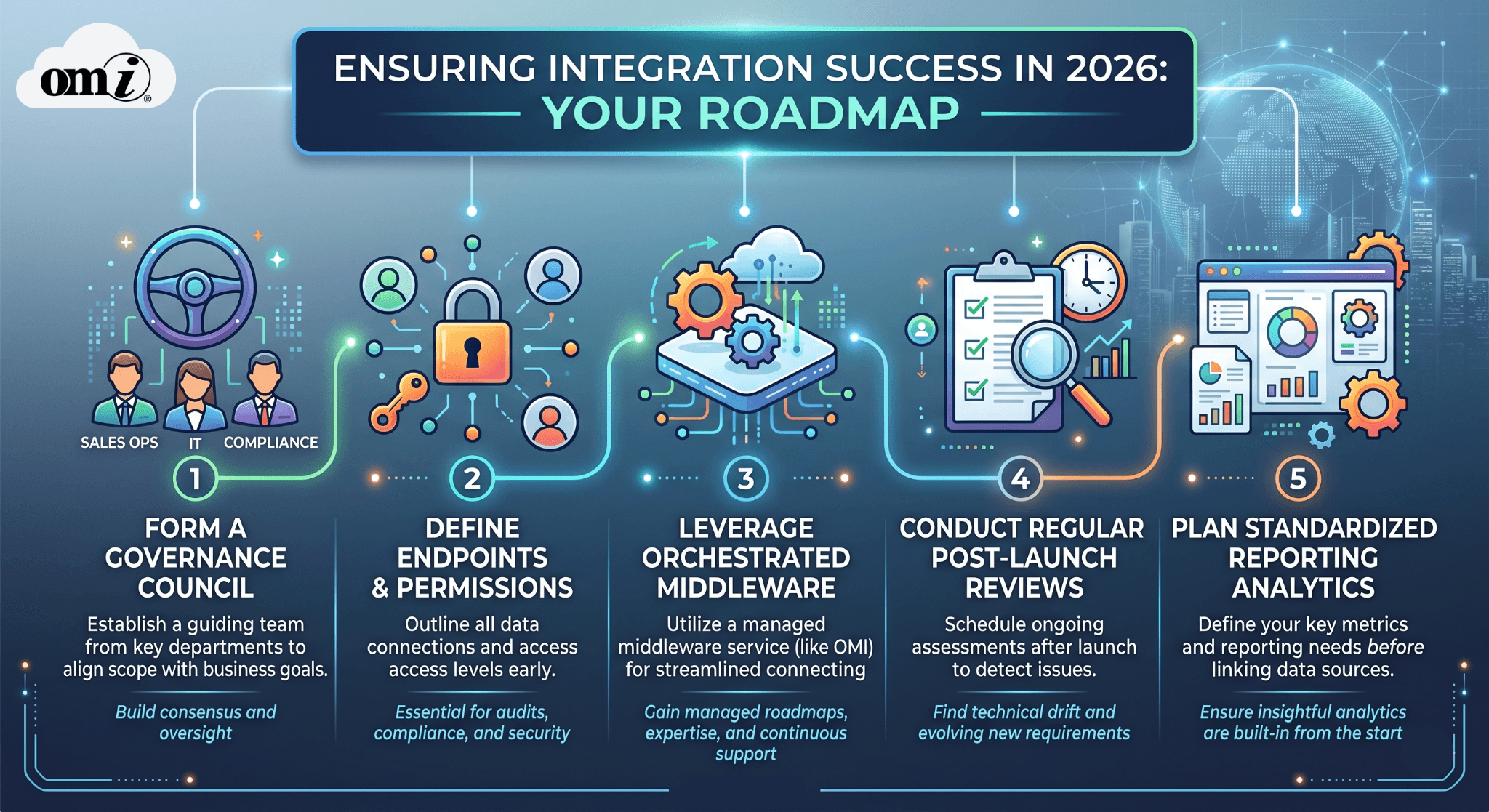
Best Practices Checklist: Ensuring Integration Success in 2026
- Set up a governance council including Sales Ops, IT, and compliance to align integration scope with business needs
- Define all endpoint and permission requirements up front, critical for audit trails and access reviews
- Leverage middleware platforms like OMI’s orchestrated service, not just for ease of integration, but for managed roadmap and support
- Schedule regular post-launch reviews to identify technical drift and evolving requirements
- Plan for standardized reporting analytics before you connect data sources
Pro-Tip (Permission Set Management):
Regularly review and update permission sets in both Salesforce and Dynamics 365 as part of a managed integration service to maintain SOC2 compliance. For deeper permission strategies, see our essentials on Salesforce workflow automation.
ROI: Cost Savings and Time Reclaimed for Mid-Market Organizations
The move from patchwork manual connections to an orchestrated, managed integration led by OMI directly enables:
- Resource redeployment: Free technical staff and business teams to focus on revenue-generating work, not system break-fix
- Compliance readiness: Eliminate audit panic and data risk by setting up permission-based, auditable CRM environments
- Scalability: Easily onboard new systems or teams as your business grows
- Reporting analytics: Empower leadership with real-time dashboards and data-backed decision making
- Reduced technical debt: Shift spending from maintenance to innovation initiatives
Many OMI clients report being able to scale their Sales Ops teams and processes with less than half the IT staff previously required, securely supporting growth without new compliance risk. Want to dig deeper into CRM ROI? See our blog on future-ready managed services.
Comprehensive FAQ: API Integration Choices for Salesforce & Dynamics
- What’s the most scalable integration choice for mid-market companies in 2026? For growth-stage firms with limited IT staff, OMI’s iPaaS-led approach delivers the scalability, governance, and managed support essential for CRM optimization. Unlike "big IT" enterprise offerings, OMI solutions are right-sized for mid-market speed and flexibility. Learn more about OMI integration services.
- When should we select a custom API build instead of a platform connector? Choose custom API development when you need unique process orchestration not addressed by standard tools. OMI’s consulting approach begins with a technical debt assessment to ensure any custom build is future-proofed and delivers clear operational ROI. See how OMI manages tailored requirements at Salesforce development services.
- How does managed integration reduce technical debt for Sales Ops teams? Managed integration centralizes cross-platform data flow, eliminating recurring manual tasks and legacy data silos. OMI’s proven roadmap supports permission set updating, lead lifecycle management, and regular compliance checks. This gives your Sales Ops team the freedom to optimize core processes. Explore managed services at OMI’s Managed Services.
- What are the risks if we delay CRM integration upgrades? Delays typically result in mounting technical debt, more manual rework for SDR/BDR teams, audit vulnerabilities, and stunted cross-team productivity. OMI’s client testimonials reveal the business cost of delay, but also how a single integration project can reclaim lost efficiency.
Conclusion: The Critical Pivot for Growth-Stage CRM Success
For mid-market leaders, 2026 is the year to shift from tactical, DIY integrations to strategic, managed orchestration. With increasing compliance demands and tighter resource environments, partnering with a specialist like OMI positions your Salesforce and Dynamics 365 stack to drive true digital transformation, reducing cost, accelerating lead lifecycle performance, and safeguarding your technical roadmap.
If your business needs a readiness audit, technical debt clean-up, or expert integration managed services, reach out to OMI. Our team has guided over 1,000 organizations through the journey from fragmented silos to unified, growth-ready digital platforms.