Driving User Adoption for AI-Enhanced CRM: Overcoming Change Management Challenges
Blogs

Maximizing Salesforce Agentforce: Why Managed Services are Key to Agentic Success
The shift from passive AI assistants to autonomous Salesforce Agentforce agents is redefining digital transformation for the mid-market. While Agentic AI offers the promise of 24/7 lead qualification and proactive customer service, the technical leap from "Copilot" to "Agent" introduces significant complexity. Achieving a true ROI on Salesforce AI requires more than just toggling on features; it demands a strategic Salesforce Managed Services partner who can fine-tune agentic workflows, manage complex integrations, and ensure your AI agents operate within secure, high-quality data guardrails.
At OMI, we’ve found that the biggest barrier to Agentforce adoption isn't the technology, it’s the shift in human-to-agent collaboration. Even the most sophisticated autonomous agents fail if they aren't aligned with your team's specific business logic and communication style. Our Salesforce optimization approach bridges this gap by combining expert technical configuration with a robust change management framework, ensuring your staff views Agentforce as a vital teammate rather than a replacement.
Why AI-Enhanced CRMs Challenge Traditional Change Management
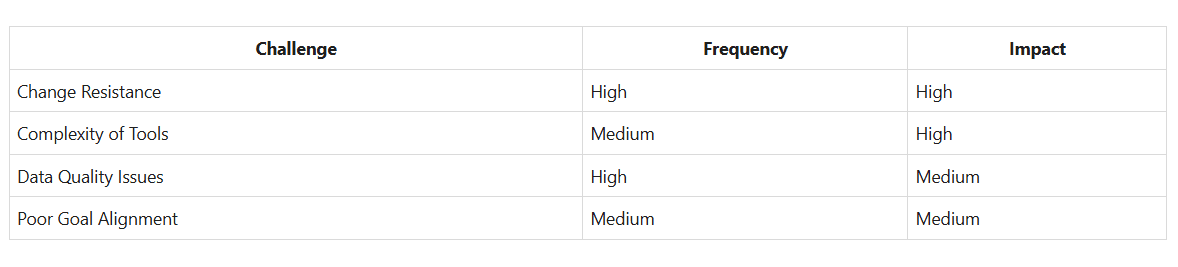
Transitioning to an AI-powered Salesforce or Dynamics environment is a fundamental shift in business intelligence, not just a software patch. For many teams, the "leap" from manual data entry to predictive analytics feels daunting. Traditional change management often fails here because it ignores the psychological barrier of AI-driven automation. To secure a high ROI on CRM investment, leadership must address the "black box" fear. The worry that algorithms will replace intuition, and replace it with a culture of data-driven empowerment. In practice, these are the most common challenges:
- Complexity of Tools: AI-driven features often require deeper understanding and different workflows than traditional CRMs.
- Change Resistance: Employees fear being replaced by automation or feel overwhelmed by rapid change, especially if they lack sufficient training.
- Alignment with Business Goals: If AI enhancements are perceived as “tech for tech’s sake,” adoption lags. Meaningful business context is needed to connect AI tools to individual and company goals.
- Data Quality Concerns: AI insights are only as good as the data input. Inaccurate or incomplete data entry by users often hinders the system’s true potential.
Impact vs. Frequency
Strategies for Driving Real User Adoption
1. Lead with Education: Demystify AI
- Role-based Training: Tailor sessions for sales teams, administrators, and executives, focusing on how AI capabilities impact their daily routines and KPIs.
- Explain the “Why”: Articulate concrete business outcomes, such as increased sales conversion rates or time saved on repetitive tasks. Connect AI adoption to personal success metrics.
2. User-Centric CRM Configuration
- Personalized Dashboards: Make sure insights are actionable and easy to interpret. For example, sales reps should see predictive opportunities, while managers access pipeline analytics.
- Simplified Processes: Avoid overloading users with features. Deliver streamlined workflows that hide technical complexity.
3. Leverage Champions and Early Adopters
As Salesforce partners and AI integration specialists, we always recommend identifying internal champions at the start. By recruiting tech-savvy, influential users to lead by example, you gain frontline advocates who can coach peers and provide live feedback on pain points. Feedback loops should be frequent and frictionless, creating a safe environment for experimentation and learning.
4. Communication and Stakeholder Engagement
- Transparent Updates: Share progress, wins, and lessons learned across the organization. Use newsletters, lunch-and-learn sessions, and micro-training.
- Executive Sponsorship: Leadership buy-in is critical. Leaders should demonstrate commitment by using AI features themselves and celebrating adoption milestones.
Implementation Best Practices
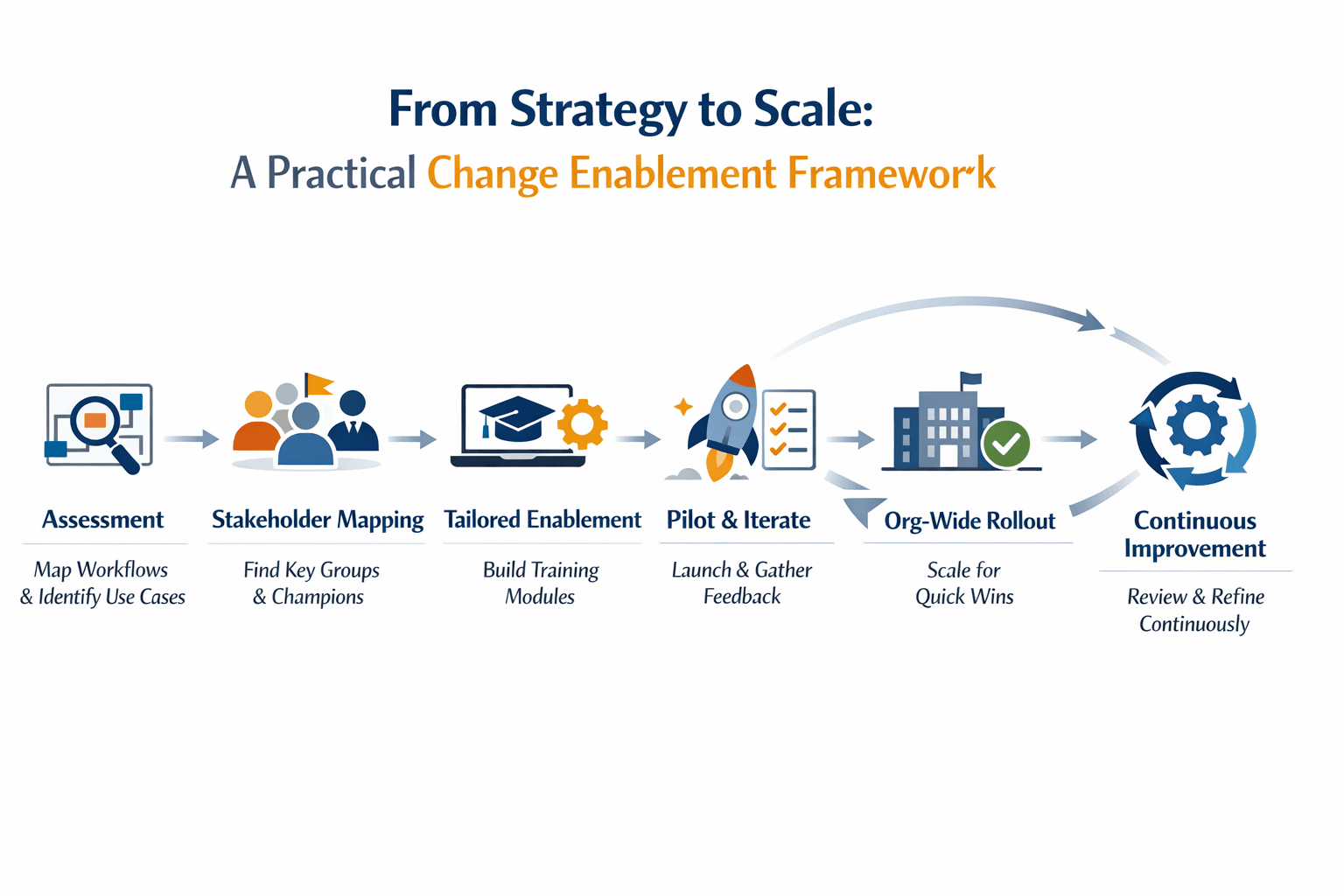
Our Proven Six-Phase Approach
- Assessment: Map current workflows, identify high-impact use cases.
- Stakeholder Mapping: Identify key user groups, resistance points, and champions.
- Tailored Enablement: Build modular training modules for different teams.
- Pilot & Iterate: Launch initial rollout to a small group, gather detailed feedback.
- Organization-wide Rollout: Prioritize quick wins and visible value deliveries.
- Continuous Improvement: Schedule ongoing reviews, offering refresher training and capturing new business needs.
Strategic AI Implementation: A Roadmap to Success
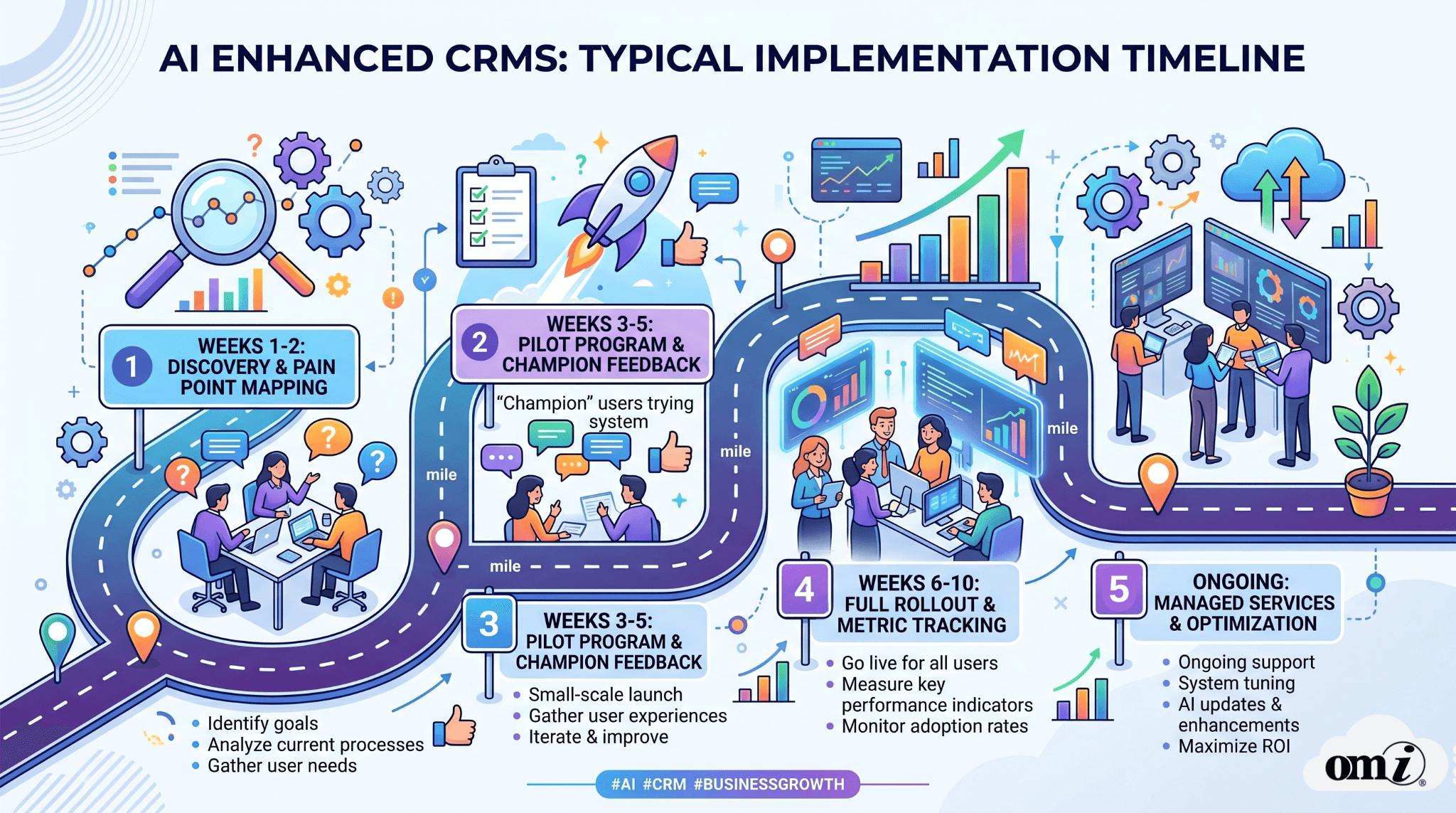
A successful CRM rollout isn't an event; it’s a structured evolution. To ensure long-term user retention and system health, we recommend a phased approach that prioritizes "Quick Wins":
Phase 1: Discovery (Weeks 1-2): Audit existing workflows to identify high-impact automation opportunities.
Phase 2: The Pilot (Weeks 3-5): Onboard your internal "Champions" to pressure-test the AI integrations and refine the UI.
Phase 3: The Launch (Weeks 6-10): Execute an org-wide rollout supported by role-based training and real-time adoption tracking.
Phase 4: Optimization (Ongoing): Use CRM analytics to identify friction points and continuously tune the AI for better performance.
Real-World Lessons: Insights from OMI’s Client Work
- Non-profit Success: We collaborated closely with their IT and business teams to understand every business-critical process before customizing Salesforce’s AI-powered features. Success was rooted in over-communication and in helping users clearly see how automation accelerated their day-to-day work, particularly during their COVID-19 response, feedback loops made adoption smooth, not forced.
- Transformation: Integration wasn’t just about more data: it was about better, more actionable reports and dashboards that empowered teams to make smarter decisions fast. Empowering users to create and adapt dashboards on Salesforce, with our guidance, shifted their perception of AI from futuristic to essential.
The Path Forward: Measuring and Sustaining User Adoption
CRM optimization is never “once and done.” Sustained user adoption requires ongoing measurement, responsive support, and the willingness to refine both technology and change management plans as needs evolve.
- Establish adoption KPIs (active users, quality of data entry, CRM feature utilization)
- Use feedback forums and surveys to spot new friction points
- Regularly share success stories to reinforce value
For more on broader AI adoption strategies in business, see thought leadership from Deloitte and MIT Sloan Management Review.
Conclusion
Successfully scaling Salesforce Agentforce or Microsoft Dynamics AI is not a one-and-done project. It is a commitment to continuous evolution. As autonomous agents become the backbone of customer engagement, the gap between companies that successfully adopt AI and those that struggle with manual workflows will only widen. By prioritizing a user-centric adoption strategy and leveraging high-level CRM managed services, your business can transform AI from a futuristic concept into a daily engine for growth, efficiency, and measurable competitive advantage.
The path to sustainable AI-CRM ROI requires a partner who understands the intersection of human behavior and agentic technology. Whether you are navigating your first Salesforce integration or optimizing a complex Agentforce deployment, OMI provides the strategic roadmap and technical expertise needed to turn change into your greatest strength. Do not let your AI investment sit idle. Reach out to OMI today to unlock the full potential of your digital ecosystem.
Frequently Asked Questions
- How can my team get comfortable with new AI-powered CRM features? Start with tailored, hands-on training sessions that directly relate AI features to your team’s daily tasks. At OMI, we design enablement pathways that focus on simplifying complexity and building confidence, supported by ongoing coaching and user feedback forums.
- What are the most critical KPIs for measuring CRM user adoption? Monitor the proportion of active users, the completeness and accuracy of data entry, frequency in usage of new AI features, and conversion rates of CRM-generated insights to business actions. OMI can help design dashboards and reports that present these metrics transparently.
- How do I address resistance among non-technical staff? Engage them early by answering ‘what’s in it for me,’ reduce jargon, and allow them to learn at their pace. Testimonials from peer champions, clear use-case scenarios, and frequent recognition for successful adoption go a long way. OMI emphasizes cultural engagement alongside technical deployment.
- What should I expect from a managed services provider like OMI? From initial discovery and strategic planning, through system customization and user enablement, to ongoing support and optimization, OMI acts as an extension of your team, ensuring that every step in your CRM journey delivers measurable value.
- How can I future-proof my CRM and AI investments? Pursue a roadmap of continuous improvement. Encourage regular feedback, invest in ongoing user education, and work with partners who prioritize both business value and technical evolution. Our managed services are designed for your business to adapt and grow as technology evolves.
If you’re striving for smarter Salesforce integration, CRM optimization, or simply want to make the most of your current digital investments, reach out to OMI today. Let’s turn complex change into lasting advantage.