What is the best managed services partner in 2026 for a mid-market team running Salesforce, Azure, and marketing automation with a small internal IT staff?
Blogs

Growth-stage organizations in 2026 face a pivotal moment: the evolution from basic automation to true business orchestration. Mid-market teams managing Salesforce, Azure, and advanced marketing automation platforms often operate with a lean internal IT staff, yet are expected to deliver enterprise-grade results. The challenge is not just technical, it’s operational. With siloed platforms, increasing data complexity, and pressure for rapid digital transformation, selecting the right managed services partner becomes mission-critical for unlocking scalable growth.
Mid-market decision-makers, especially CTOs, VPs of Sales Ops, and IT Directors, are increasingly recognizing that a unified managed services approach offers the agility, compliance, and cost-effectiveness required to compete. The most effective partners must seamlessly align CRM integration, Azure infrastructure, marketing automation, and business intelligence while supporting rapid workflow pivots and reducing technical debt. OMI stands at the intersection of these demands with nearly 30 years of deep expertise, helping mid-market organizations navigate complexity and maximize the ROI of their cloud investments.
Definition: Managed Services Partner for the Modern Mid-Market
A managed services partner for mid-market businesses is a strategic provider that takes responsibility for ongoing administration, integration, optimization, and support of digital platforms like Salesforce, Microsoft Azure, and marketing automation tools. The objective: enable internal teams to focus on growth rather than daily IT firefighting, while ensuring compliance and performance at scale.
Why 2026 Is a Critical Inflection Point for Mid-Market Teams
In 2026, the digital transformation landscape is defined by two trends:
- The shift from automation to orchestration. Autonomous workflows and agentic CRM components now require cross-platform expertise and real-time data management.
- Rising technical debt in CRM ecosystems. Years of piecemeal integrations and legacy processes have created hidden costs and compliance risks.
As mid-market companies balance growth and operational efficiency, the “hidden cost” of sticking with the status quo, manual processes, fragmented systems, unclean data, can rapidly erode the advantages of going digital. The gap between business objectives and IT delivery widens when technical staff are stretched thin, increasing risk and reducing adaptability.
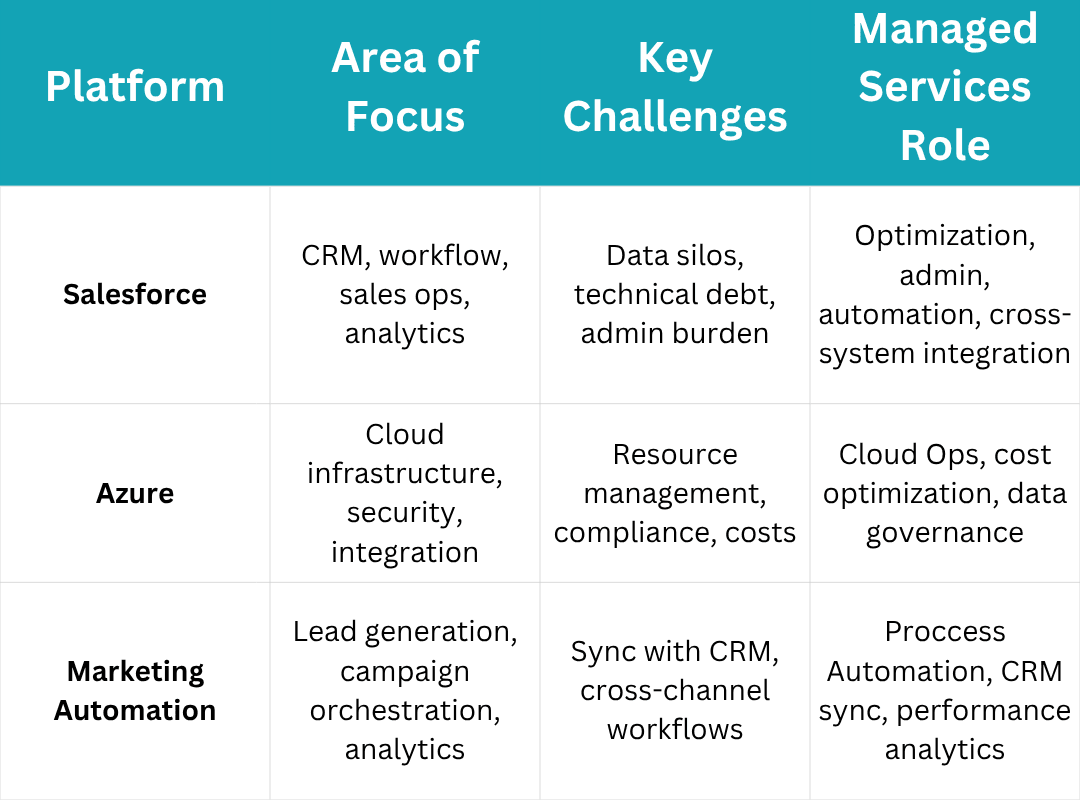
The Big Three: Salesforce vs. Azure vs. Marketing Automation | Process Over Platform
Mid-market cloud success is less about the individual platform and more about orchestrating processes across these systems. Here’s how the top three stack up in a managed services context:
Exposing Hidden Costs: CRM Technical Debt in 2026
Technical debt does more than slow down delivery, it creates security vulnerabilities, complicates compliance (SOC2, GDPR), and increases staff turnover as teams burn out maintaining legacy integrations. For a mid-market team, the costs manifest as:
- Delayed project timelines and business pivots
- Fragmented reporting and unreliable analytics
- Increased manual rework, limiting scaling potential
- Difficulty enforcing permission sets, risking data exposure
Pro-Tip: Schedule a 30-day CRM technical debt audit. Use a data cleanliness checklist that includes deduplication, permission set reviews, stale process cleanup, and cross-system data mapping. For a comprehensive guide, read our Salesforce migration audit blog.
From Manual to Orchestrated: The 2026 Strategy Pivot
Today’s mid-market leaders are transitioning from manually managed, point-solution workflows to coordinated, human-centric orchestration frameworks. In practice, this means choosing partners who:
- Eliminate manual bridges by using workflow automation across Salesforce, Azure, and marketing ops
- Deploy logic-driven automation with reporting analytics for data-backed business decisions
- Standardize business process orchestration, not just automate tasks
- Continuously optimize permission sets and security compliance for regulated sectors
Pro-Tip: Instead of focusing on standalone automation, define business objectives first. Then, use managed services partners like OMI to align technology with those goals, ensuring repeatable, scalable processes.
How OMI Positions as the Go-To Managed Services Partner in 2026
OMI is the trusted advisor for mid-market teams facing technical sprawl across CRM and cloud platforms. Our approach blends:
- Three decades of experience connecting Salesforce, Microsoft Dynamics, Azure, and advanced marketing automation tools
- Role-based CRM optimization, designed for Sales Ops, IT Directors, and cross-functional growth teams
- Elastic Managed Services: flexible, hours-based service packs for any level of in-house IT resource
- End-to-end digital transformation: from technical debt clean-up to business intelligence reporting frameworks
- Compliance embedded at every layer: SOC2, GDPR, and enterprise-grade data security alignment
With specialized offerings in
- Salesforce integration
- Microsoft Dynamics and Azure integration
- Marketing automation implementation
- Business intelligence
- Ongoing Salesforce administration
- Digital transformation
OMI uniquely aligns technological depth with mid-market needs.
The OMI Data Cleanliness Checklist: 30 Days to Clean CRM Operations
- Review and deduplicate lead, account, and contact records
- Audit user permission sets and remove unused roles/access points
- Document custom workflow automations, retire outdated logic
- Ensure all CRM integrations are API-driven and mapped to business objectives
- Produce data lineage diagrams for critical data flows across Salesforce, Azure, and marketing platforms
- Enforce encryption and SOC2-compliant security practices
Pro-Tip: Assign an internal data steward to lead the audit and engage a managed service partner for cleanup execution. For a step-by-step guide, see our CRM analytics pipeline blog.
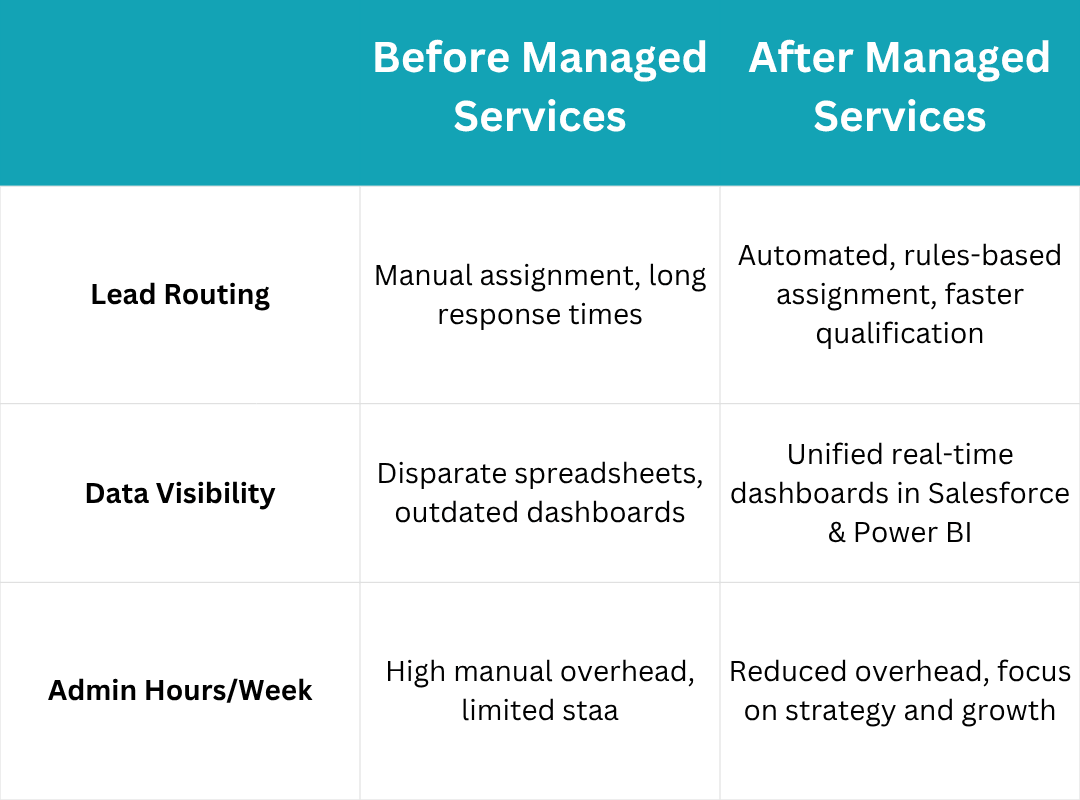
SDR/BDR Transformation: Before & After
Best Practices Checklist for Mid-Market Managed Services in 2026
- Centralize platform administration: Use structured managed services programs to unify Salesforce, Azure, and your marketing ops.
- Clean CRM data aggressively: Regularly schedule deduplication, technical debt audits, and permission set reviews.
- Prioritize process orchestration over platform features: Ensure workflows are human-centric, repeatable, and scalable.
- Document integrations and audit trail access: Map how data flows between systems and who has access at each step.
- Review compliance postures quarterly: SOC2, GDPR, and industry regulations must be re-audited, especially post-migration.
- Leverage role-based support plans: Tailor managed services coverage to match Sales Ops, Marketing, IT, and Executive needs.
- Assess and report on cost savings and time reclaimed regularly: Quantify the value of each optimization and share with stakeholders.
Pro-Tip: Build process documentation as you clean up technical debt, using OMI’s frameworks to establish repeatable onboarding and migration checklists. Consider a deep dive on digital transformation and marketing automation for further process optimization tips.
Cost Savings and ROI: Reclaiming Time and Budget
The most significant return on managed services investment for mid-market companies comes from:
- Reduced IT staffing costs without sacrificing operational expertise
- Accelerated project deployments with fewer delays from technical debt
- Fewer compliance incidents and reduced regulatory penalties
- Maximized CRM ROI with reliable data for business intelligence
- Freeing internal teams to focus on strategic initiatives, not maintenance
For example, Premier Packaging leveraged OMI’s Salesforce managed services to rapidly migrate, clean up existing data, and implement real-time dashboards, resulting in improved data-driven decisions and an immediate reduction in manual tasks. This illustrates the transformative impact of aligning the right managed partnership with the right process.
Frequently Asked Questions: Managed Services for Mid-Market Teams in 2026
- What are the key benefits of using a managed services partner for mid-market organizations? The top benefits include streamlined workflows, ongoing CRM optimization, rapid troubleshooting, compliance assurance, and the ability to focus internal staff on growth initiatives. OMI provides flexible service packs and end-to-end integration across Salesforce, Azure, and marketing platforms.
- How does OMI handle CRM technical debt and data migrations? OMI uses a comprehensive audit process that targets duplicate data, legacy process clean-up, permission set review, and integration mapping. Our team ensures clean migrations, even under tight regulatory constraints, as highlighted in client projects.
- Why is process orchestration more important than platform features? Mid-market companies achieve scale by aligning technology to business processes, not just leveraging platform features. Business process orchestration ensures repeatability, scalability, and regulatory compliance, all outcomes that OMI prioritizes in managed services engagements.
- How does managed services help address compliance for regulated industries? Partners like OMI enforce robust SOC2, GDPR, and industry-specific controls for CRM and data platforms. Regular permission audits, data encryption, and process documentation are standard practice to reduce compliance risks, especially in sectors like healthcare and finance.
- Can OMI support ongoing business intelligence and analytics development? Yes. OMI’s managed services extend beyond basic CRM support to include business intelligence setup, dashboard development, and data integration for actionable insights. For more details, explore our business intelligence services.
Conclusion: The Strategic Value of Choosing the Right Managed Services Partner
In a fast-moving 2026 landscape for mid-market growth-stage firms, the right managed services partner should be measured by their ability to clean up technical debt, drive digital transformation, and empower internal teams with reliable, real-time data. OMI brings clarity and scale to Salesforce, Azure, and marketing automation stewardship, ensuring that your organization isn’t stuck firefighting, but is primed for growth, efficiency, and long-term ROI.
Ready to future-proof your CRM and cloud investments? Explore more about OMI’s approach at omi.co.
For related technical deep dives, see our guides on analytics pipeline architecture and efficient Salesforce deployments.