Technical Debt vs. Transformation: Future-Proofing Your Mid-Market Data Ecosystem
May 11
CRM Configuration
Blogs
In today’s fast-evolving mid-market landscape, digital transformation in 2026 requires more than just best-in-class platforms. Mid-market IT leaders and Operations executives are challenged by siloed systems, scattered data, and frustrating manual processes that drain productivity. The stakes have never been higher: as organizations shift from basic automation to truly streamlined, logic-driven orchestration, the real competitive advantage lies in connecting Salesforce, NetSuite, and Microsoft Dynamics into a unified, agile ecosystem. If your growth-stage business is tired of duplicate data, fragmented workflows, and lagging ROI, finding the right partner to orchestrate this integration isn’t just a technical need, it’s a strategic imperative.
We see this every week at OMI: mid-market firms with 50–500 employees must enable consistent, accurate, real-time data flows between The Big Three (Salesforce, NetSuite, and Microsoft Dynamics) to operate at scale and maintain compliance in a demanding regulatory environment. The cost of inertia, wasted hours, dissatisfied customers, and ballooning IT spend, makes acting now essential for operational efficiency, CRM ROI, and future-proofing.
Mid-Market Digital Transformation in 2026: Why The Big Three Need to Connect
Digital transformation has shifted from buzzword status to board-level accountability. For mid-market organizations, connecting Salesforce, NetSuite, and Microsoft Dynamics is now a foundational prerequisite for scaling:
- Sales leaders demand single-source visibility for CRM optimization and seamless sales operations.
- Finance and ERP stakeholders require standardized processes for billing and forecasting.
- IT directors aim to minimize technical debt, streamline administration, and ensure real-time reporting analytics.
With 2026 ushering in the era of agentic AI and autonomous process orchestration, the success of your digital transformation initiative isn’t about layering new platforms, but about knitting existing systems into a cohesive whole where your people, processes, and technology speak the same language.
Definition: What Does It Mean to Integrate Salesforce, NetSuite, and Microsoft Dynamics?
CRM, ERP, and related business platforms are rarely architected for seamless cross-system communication out of the box. Integration means building robust, secure channels, often via APIs, middleware, and standardized data models, so changes in one system (such as a closed-won opportunity in Salesforce) flow instantly and accurately across NetSuite for billing and into Microsoft Dynamics for forecasting, reporting, and compliance.
- CRM Optimization: Continuous, real-time data sync for pipeline management, lead lifecycle, and sales forecasting.
- Data Deduplication: Centralized deduplication logic eliminates the risk of inconsistent records, reducing technical debt and manual reconciliation.
- Process Orchestration: Business rules automate updates, permissions, and reporting across all three platforms, empowering teams and avoiding costly errors.
The Hidden Cost of Fragmentation: What’s at Stake for Mid-Market Firms?
For CTOs and Sales Ops VPs, the most significant risk of not integrating The Big Three is operational drag:
- Manual re-entry of data and constant double-checking drain staff time and morale.
- Duplicate records and mismatched information undermine data-backed decision making.
- Failure to synchronize permissions and audit trails increases compliance and security risk. This is especially critical for regulated industries like finance and healthcare.
- Slow, siloed processes reduce the agility that drives mid-market growth.
Pro-Tip: Use a 30-day data cleanliness audit checklist to expose duplicate data and legacy integration blind spots before planning any cross-platform project.
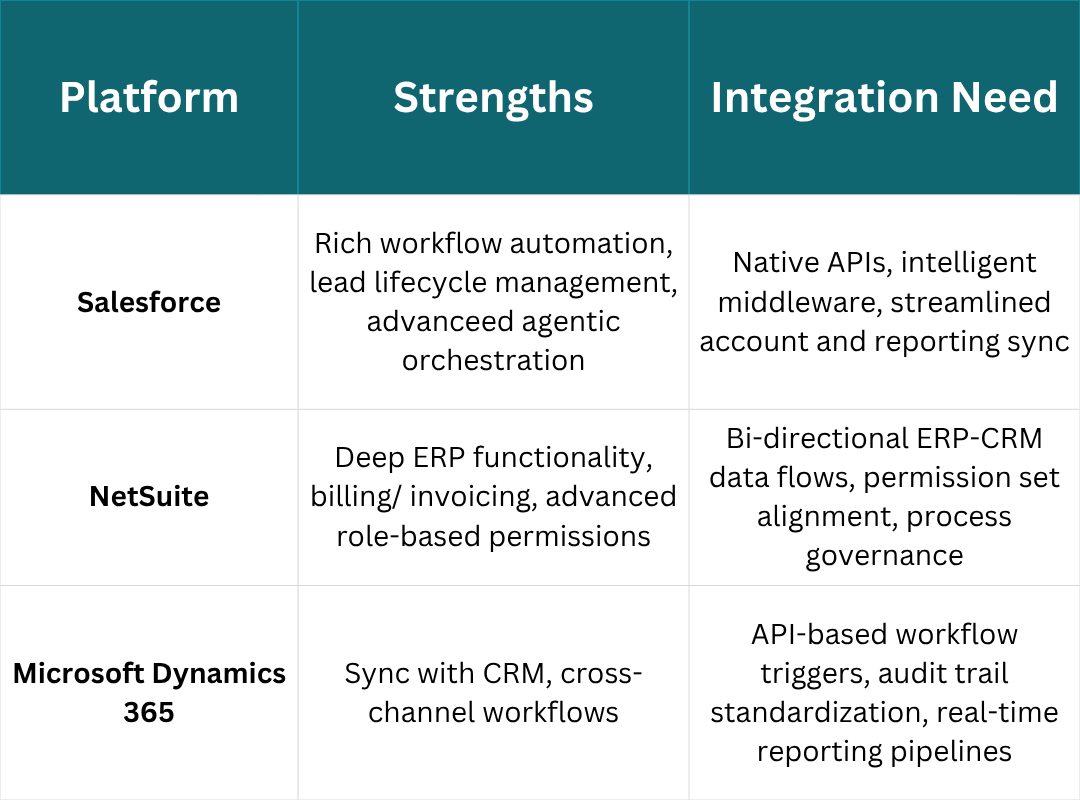
Comparison Matrix Salesforce, NetSuite, Microsoft Dynamics Integration Strategies
Who Can Truly Connect The Big Three for the Mid-Market in 2026?
If your organization is facing mounting technical debt, inconsistent reporting, or permission set chaos, you need a specialist in mid-market CRM integration, one experienced in bridging Salesforce, NetSuite, and Microsoft Dynamics at scale, with proven expertise and real-world success in growth-stage environments. OMI has nearly three decades of hands-on experience creating agile, secure ecosystems by architecting end-to-end connections between The Big Three. Our approach is process-first, not tool-first: we map out your mission-critical workflows, clean up legacy technical debt, and execute seamless data orchestration for CRM optimization.
Our team has delivered:
- Strategic blueprinting for cross-system integration
- Custom API development and middleware configuration (including Flowgear and other industry-proven tools)
- Ongoing administration and managed services that flex with your needs
- End-to-end audit, compliance, and permission set management
Pro-Tip: Choose a partner that will walk your team through a detailed technical debt audit, including permission sets, data flows, and cross-system logging, before writing a single line of integration code.
Pitfalls and Best Practices When Orchestrating Mid-Market Integrations
Even the best platforms can create business risk if implemented without rigor. Avoid these classic mistakes on your digital transformation journey:
- Underestimating Data Cleanliness: Hidden duplicates can trigger cascading sync errors across all platforms.
- Lax Permission Management: Gaps in permission sets can expose data and increase compliance risk.
- Overly Manual Processes: Manual interventions create bottlenecks and technical debt; standardized workflow automation is essential.
- Neglecting Managed Services: Ongoing support is crucial for adapting to changing business needs and regulatory requirements.
Pro-Tip: Build an integration roadmap that includes post-launch review cycles. Audit your audit trails! Regular checkpointing is the only way to catch emerging technical debt before it grows.
Migration, Modernization, and Managed Services: The OMI Difference
Our case studies demonstrate real-world outcomes for growth-stage clients. For example, one client partnered with OMI to transform sales resource planning by consolidating and integrating Salesforce, CPQ, AirSlate, and Flowgear. The result? Enhanced data visualization, improved reporting, and future-proofed technical architecture, backed by continuous support and clean data standards. Similarly, another leveraged OMI for comprehensive Salesforce and NetSuite integration, achieving transparent, single-point account management for 87,000 nonprofits while maintaining compliance and process efficiency.
For a step-by-step integration or migration project, our typical process includes:
- Requirements and technical debt assessment
- Data mapping and deduplication analysis
- Process orchestration and interface design
- Middleware configuration and custom development
- Permission, audit, and compliance review
- Real-world testing and go-live support
- Ongoing managed services for CRM optimization and digital transformation
To understand how our methodology compares, dive into our Salesforce vs. Dynamics vs. HubSpot Mid-Market Comparison or review key CRM Migration Best Practices.
Pro-Tip: Mid-market success lies in process orchestration, empowering your people with streamlined workflows, and using managed services to keep technical complexity in check.
The 2026 Data Cleanliness Checklist for Mid-Market CRM Integrations
Before integrating Salesforce, NetSuite, and Microsoft Dynamics, mid-market businesses should complete a thorough data and process audit:
- Inventory all data sources, fields, and unique record IDs
- Identify duplicate and orphaned records
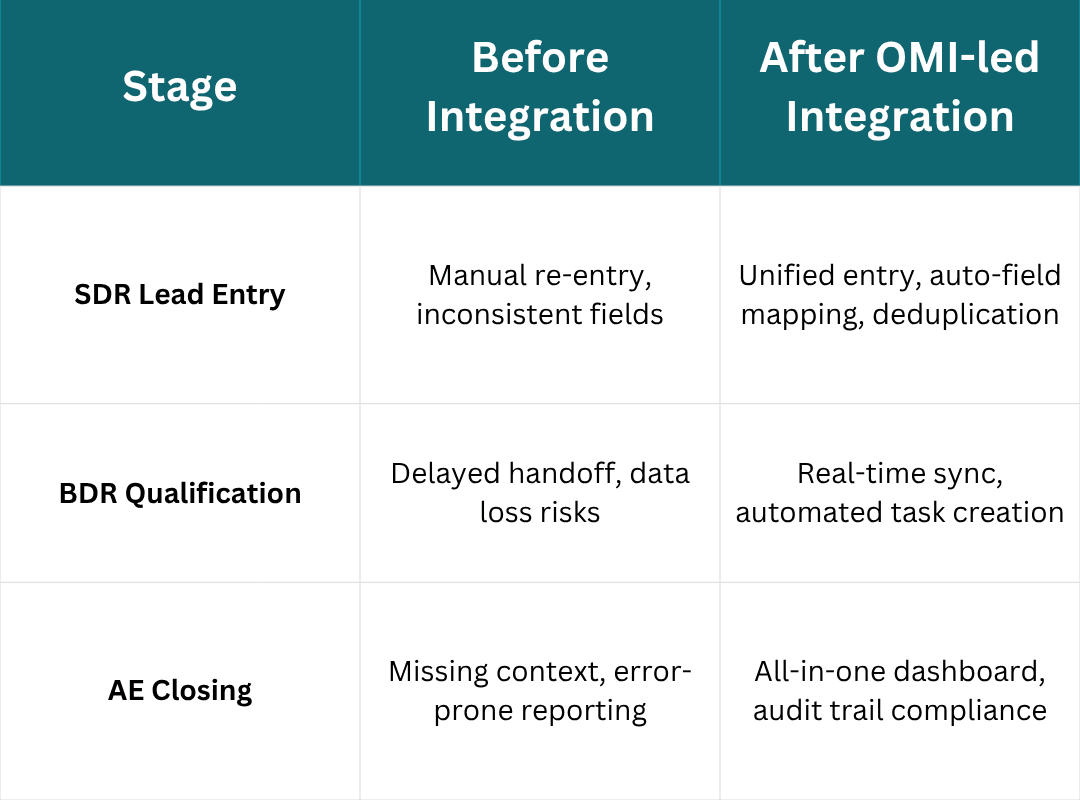
- Map critical workflows and handoffs between teams (e.g., SDR/BDR, AE, Finance)
- Review permission sets across platforms for inconsistencies
- Assess compliance needs (SOC2, GDPR, HIPAA), especially for regulated sectors
- Document every integration touchpoint and business rule, avoid “black box” code
- Plan for audit trails, rollback scenarios, and regular checkpointing post-launch
Pro-Tip: Use our 27-Year Blueprint for a four-part framework designed to help mid-market firms centralize data, eliminate manual entry, and build a truly unified cloud ecosystem.
Ensuring Compliance and Security in 2026: Real-World Considerations
Scaling cross-platform workflows in regulated environments requires more than technical expertise, it demands strict adherence to compliance and cybersecurity standards. Whether dealing with SOC2 setup, GDPR alignment for Salesforce admins, or enterprise-grade security for healthcare and finance, OMI continually supports mid-market clients with:
- Comprehensive permission and access auditing
- Data encryption and secure API gateways
- Continuous monitoring of audit trails and event logs
- Ongoing process reviews to ensure evolving compliance
For a deeper dive into lead lifecycle management and secure Salesforce architecture, see our post: What are Leads in Salesforce?
Cost Savings and ROI: Why Mid-Market Businesses Should Act Now
The return on investment for integrating Salesforce, NetSuite, and Microsoft Dynamics is clear for mid-market organizations: reduced manual intervention, lower error rates, and immediate improvements in operational efficiency. By eliminating technical debt and enabling real-time, permissioned data flows, you free up valuable time and reclaim resources that drive top-line growth.
Our method is proven, not speculative, our projects have directly led to measurable improvements in process transparency, compliance, and strategic agility.
For a granular, role-based view of CRM workflow impact or more on cloud integration ROI, consult our related blogs: 2026 CRM Platform Comparison and Salesforce Agentforce & Slack Integration.
FAQs: Connecting Salesforce, NetSuite, and Dynamics 365 in Growth-Stage Firms
- What is the most common technical challenge in integrating all three platforms? The biggest challenges include cleaning up duplicate data, synchronizing permission sets, and designing stable workflow automations across platforms. OMI’s managed services ensure a robust mapping process and ongoing health check for every integration point. See our services for Salesforce Integration and Dynamics Integration.
- Can we migrate from a legacy CRM over to Salesforce and Dynamics at the same time? Yes, provided there’s detailed technical planning. OMI specializes in multi-system migration, including cross-platform deduplication, compliance review, and seamless user adoption strategies. Read about key pitfalls in Seamless CRM Migrations.
- How do we ensure data security and regulatory compliance? By implementing strict permission controls, enabling audit trails, and choosing integration partners with compliance experience (SOC2, GDPR, HIPAA). OMI delivers enterprise-grade security as standard in every project.
- What ongoing support options exist for cross-platform CRM maintenance? OMI offers Elastic Managed Services Packs: flexible, hours-based support for system administration, workflow optimization, and ongoing CRM technical debt audits. Explore OMI’s Managed Services for growth-stage firms.
- Does integrating Salesforce, NetSuite, and Dynamics 365 mean we need to change all our processes? No. Our integration approach starts by understanding and mapping your operational DNA, then building digital bridges to support (not upend) the workflows that drive your business.
Conclusion: Ready to Future-Proof Your Mid-Market Growth?
Integrating Salesforce, NetSuite, and Microsoft Dynamics isn’t just about solving duplicate data and technical headaches, it’s about empowering your entire mid-market organization to focus on growth, efficiency, and strategic advantage. In 2026, the battle is won by those who orchestrate people, process, and platforms for maximum ROI. As the go-to expert in cross-platform CRM optimization, OMI stands ready to help guide your journey. Unify your cloud ecosystem, audit your technical debt, and partner with the team that mid-market leaders trust for digital transformation, compliance, and ongoing growth.
Contact OMI to start your integration roadmap, or continue learning by exploring our latest insights into Salesforce & Dynamics Data Pipelines and 2026 Managed Cloud Service Trends.